Today's
EarthStation1.com 15% (Or More!) Off Commemorative Memorial Title:
UFO MP3s Collection: Alien Phenomena CD, MP3 Download, USB Drive
Today, July 5, 2026
( #JCKaelin here: It appears from the
historical record that that our founder and proprietor #JCKaelin
is also Saint Doktor Reverend Wandarer (aka Rev. Eyre Rend aka
EyeRend) of this same Church of the Subgenius ;), who ran and
curated the church's online audio archives during the early and
mid 1990s. Praise Bob! EYIEYIEYIEYIEYEYIEYI!!!!! [that's The
SubGenius Salute, an imitation of a certain wascawy wabbit using
his index finger to roughly stroke up & down the adam's apple
of his enemies :) ] ) ========= July 5: X-Day (Church of the
SubGenius [CotSG]): -- A traditional part of the Church of the
SubGenius, a parody religion formed as a burlesque of cults and
extreme religious groups, and their pamphlets and claims. X-Day
fell on July 5, 1998, the scheduled "end of the world",
and has been celebrated on July 5 each year since then. From its
inception in 1980, the Church had prophesied that an army of alien
invaders (known as the "X-ists" or "Men From Planet
X") would land on the planet Earth and destroy the world of
"normals", "pinks", and "glorps,"
while the members of the Church of the SubGenius would be rescued
by the aliens and taken away into space. Chapters 10 and 11 of
Revelation X: The "Bob" Apocryphon supply additional
details as to the precise kinds of fates which supposedly await
the "pinks" and "normals" (as well as SubGenii
who have not paid their membership fees) left behind when X-Day
comes, saying, among other things, that those who are not
immediately killed by the aliens will be enslaved by a society of
evil clowns known as the "Bozo Cult" until eventually
their souls are devoured by the Elder Gods. The book also tells
readers that if they want more information, they should send one
million dollars to Ivan Stang so that he can remake his 1973 film
Let's Visit the World of the Future. When July 5, 1998 arrived and
no alien fleet appeared in the sky, members of the Church began
citing a large number of conspiracy theories to explain why the
predicted end of the world did not take place. The manual page of
the date program claims that the Church "declared that it had
got the year upside down" and that X-Day will actually take
place in 8661. The most popular explanation for the failure of the
prophecy in the Church is usually summarized with the statement,
"the calendar is wrong and July 5th, 1998 has not really
arrived yet." Because of this, the Church has held annual
gatherings around July 5 of each year since 1998 to celebrate
X-Day and greet the arrival of the anticipated alien "Sex
Goddesses." No flying saucer rendezvous has been confirmed as
of 2022, but members of the Church have been undaunted. A more
recent theory suggests that the X-ists did indeed come to Earth on
July 5, 1998 as foretold by "Bob," but through one of
the most pervasive Conspiracy coverups, Earth and Mars were
switched, and the "Earth" we know is actually Mars. And
thus, as there was nobody on the True Earth at the time of their
arrival, there was nobody there to witness the Rupture. The X-Day
celebration has become well known in underground culture circles,
especially in pagan communities. Many underground rock bands have
performed at X-Day, and the event has evolved into a festival
similar to Burning Man, lasting for three to five days, with rock
concerts, artistic events, bonfires, and parties taking place day
and night. Of the various X-Day celebrations that have taken
place, the largest and most popular each year was held at the
Brushwood Folklore Center in Sherman, New York until 2011, when it
was relocated to the Wisteria Event Campground in Pomeroy, Ohio.
In 2021 it was announced that the "official" X-Day would
be moved again to the Land of ID resort in Land o' Lakes, Florida.
Regular events at X-Day include a symbolic effigy burning of J.R.
"Bob" Dobbs (the founder of the Church of the
SubGenius); a baptism ("Bob"tism) where participants
have their sins "washed away", "and receive new
ones in return"; concerts and performances by underground
rock bands and performance artists; theme camps; and an auction
where participants are encouraged to donate strange, unusual, and
offensive items of all sorts (including themselves). "Burners"
familiar with the Burning Man event have been upset by the fact
that X-Day is not a commerce-free event in the fashion of Burning
Man - the bands and participants at X-Day are, in fact, encouraged
to sell their own items, music CDs and albums, and other
paraphernalia. The Church of the SubGenius has responded to these
complaints with the statement that it is not a non-profit church:
"We're for-profit, we want profit, and we want to cast out
false prophets." However, the Church's status as an
independent corporation with no corporate affiliations has ensured
that large, mainstream companies have avoided the X-Day
celebration, allowing independent artists and underground
performers to flourish. The Church claims to be the only religious
organization that is "proud to pay its taxes". On Sale
Until Midnight Tonight PT!
https://store.earthstation1.com/ufo-mp3s-tv-radio-and-audio-recordings-mp3-33.html
Today's
EarthStation1.com 15% (Or More!) Off Commemorative Memorial Title:
Nuclear War Films #2 Bikini Atomic Tests, Review DVD, MP4, USB
Drive
Today, July 5, 2026
July 5: National Bikini Day: -- On July
5, 1946, the bikini swimsuit goes on sale after debuting during an
outdoor fashion show by designer Louis Reard at the Molitor Pool
in Paris, France worn by 18-year-old French nude dancer model from
the Casino de Paris, Micheline Bernardini. Since July 5, 1946,
women have been hitting the beaches and poolsides in bikinis.
National Bikini Day marks the anniversary of the invention of the
revealing two-piece bathing suit. Named after the Bikini Atoll,
where the United States conducted atomic tests, the two-piece
bathing suit made its debut in Paris. French designer Jaques Heim
wanted to name revealing bits of fabric "atom," but
designer Louis Reard named his piece, revealed on this day in
1946, with the name "bikini" and the word stuck. By
World War II, sunbathers cast aside the chaste one-piece bathing
costumes for simple two-piece bathing suits. However, nothing
prepared the United States for the revealing bikini when it hit
the beaches on July 5, 1946. The skimpy strips of fabric were seen
as less than a women's unmentionables. While Europe
enthusiastically donned the bikini after a long and arduous world
war, American's sense of decency kept them from accepting the
bikini until the 1960s. Today, the bikini comes in all shapes,
sizes, colors, and fabrics. Designers expanded the style to
flatter more body shapes, enticing more women to wear the fashion.
Throughout the summer, the beaches and pools call for swimwear. If
you're considering the bikini, perhaps the celebration is the day
to pick one that fits your style. To observe National Bikini Day:
Wear your bikini or go shopping for a new one; Go to the local
pool or beach for a swim; While you're sunbathing, learn about the
changing fashions of swimwear through the ages; Share your
favorite styles and looks using #NationalBikiniDay on social
media. On Sale Until Midnight Tonight PT!
https://store.earthstation1.com/nuclear-war-films-2-dvd-bikini-atomic-tests-and-nuclear-testin2.html
Today's
EarthStation1.com 15% (Or More!) Off Commemorative Memorial Title:
Thomas A. Edison: The Wizard Of Menlo Park + 3 Bonus Titles MP4
DVD
Today, July 5, 2026
July 5: National Workaholics Day: -- A
day meant to remind us to find a good balance between our home and
work life. In general, workaholics tend to put work before almost
everything else. This includes family, friends, and even their own
health for the sake of work performance and their quest for
perfectionism. As a result, multiple areas of their lives are
affected negatively. Their love life can fall apart and they can
become lethargic if they don't properly take care of themselves.
On National Workaholics Day, we are reminded to make sure to care
for ourselves outside of work as well! Work ethic has changed many
times over the centuries. During the sixteenth century, Puritans
redefined work as an obligation that benefited everyone in society
and the idea of "good works" was formed. They viewed
diligent work as a sign of grace, while Catholics saw work as a
requirement and a manifestation of the faith they received. This
tethering of faith and work would remain throughout the centuries
as the world evolved. When Puritans settled in the New World, they
brought their work ethic along with them. They escaped religious
persecution and created the idea of the Colonial American Dream,
built on the idea that good works brought prosperity. They built a
society in the New England area based on the beliefs of ambition,
hard work, and the constant pursuit of success, and believed that
by living this way, their workmanship on Earth would be rewarded
in heaven. German sociologist Max Weber defined this concept in
his book "The Protestant Ethic and the Spirit of Capitalism,"
published in 1905. Labor ideology had a radical shift during this
time, as the Industrial Revolution mechanized labor. The
small-scale workshops faded away as the industrialization of the
manufacturing process increased mass consumption. This was less
faith-based as the individual workmanship of the person was
removed in favor of the machine. The 1950s brought about another
change in labor dynamics. Young workers were eager to rise through
the company, follow the rules, and please their bosses. Fortune
magazine referred to this as the "grey flannel mentality"
for their risk-aversed approach. In 1968, comedian Rodney
Dangerfield came up with the word "workaholics" when he
described his father and his relationship with alcohol to cope
with the burdens of work. Today, many people still have an
unhealthy work-life, and National Workaholics Day is used to
remedy that. On Sale Until Midnight Tonight PT!
https://store.earthstation1.com/thomas-a-edison-the-wizard-of-menlo-park-dvd.html
Today's
EarthStation1.com 15% (Or More!) Off Commemorative Memorial Title:
Isaac Newton: Portraits Of Newton DVD, Video Download, USB Flash
Drive
Today, July 5, 2026
July 5, 1687: First Publications:
Science: The History Of Science: Mathematics: The History Of
Mathematics: Physics: The History Of Physics: Philosophy: Natural
Philosophy: Copernican Revolution: Philosophiae Naturalis
Principia Mathematica (English: The Mathematical Principles of
Natural Philosophy) (The Principia): -- Isaac Newton publishes one
of the most important works in the history of science,
Philosophiae Naturalis Principia Mathematica (Latin for
Mathematical Principles of Natural Philosophy), often referred to
as simply the Principia, a work in three books written in Latin.
After annotating and correcting his personal copy of the first
edition, Newton published two further editions, in 1713 and 1726.
The Principia states Newton's laws of motion, forming the
foundation of classical mechanics; Newton's law of universal
gravitation; and a derivation of Kepler's laws of planetary motion
(which Kepler first obtained empirically). In formulating his
physical theories, Newton developed and used mathematical methods
now included in the field of calculus. But the language of
calculus as we know it was largely absent from the Principia;
Newton gave many of his proofs in a geometric form of
infinitesimal calculus. In a revised conclusion to the Principia,
Newton used his expression that became famous, Hypotheses non
fingo ("I formulate no hypotheses"). On Sale Until
Midnight Tonight PT!
https://store.earthstation1.com/isaac-newton-portraits-of-newton-dvd-documentary.html
Today's
EarthStation1.com 15% (Or More!) Off Commemorative Memorial Title:
British Public Information & Propaganda Films DVD, Download,
USB Drive
Today, July 5, 2026
July 5, 1948: Health Care: National
Health Care (Publicly Funded Health Care, Public Health Care,
Public Health Care): The National Health Service (NHS) (National
Health): -- The National Health Service (NHS) is founded when the
National Health Service Acts create the national public health
system of the United Kingdom. From the first day, Minister Of
Health for the United Kingdom Aneurin Bevan had at its heart three
core principles: 1) that it meet the needs of everyone, 2) that it
be free at the point of delivery, and 3_ that it be based on
clinical need, not ability to pay. The National Health Service
(NHS) is the umbrella term for the publicly funded healthcare
systems of the United Kingdom, comprising the NHS in England, NHS
Scotland and NHS Wales. Health and Social Care in Northern Ireland
was created separately and is often locally referred to as "the
NHS". The original three systems were established in 1948
(NHS Wales/GIG Cymru was founded in 1969) as part of major social
reforms following the Second World War. The founding principles
were that services should be comprehensive, universal and free at
the point of delivery-a health service based on clinical need, not
ability to pay. Each service provides a comprehensive range of
health services, provided without charge for people ordinarily
resident in the United Kingdom apart from dental treatment and
optical care. In England, NHS patients have to pay prescription
charges; some, such as those aged over 60, or those on certain
state benefits, are exempt. Taken together, the four services in
2015-16 employed around 1.6 million people with a combined budget
of _136.7 billion. In 2024, the total health sector workforce
across the United Kingdom was 1,499,368 making it the seventh
largest employer and second largest non-military public
organisation in the world. When purchasing consumables such as
medications, the four healthcare services have significant market
power that influences the global price, typically keeping prices
lower. A small number of products are procured jointly through
contracts shared between services. Several other countries either
copy the United Kingdom's model or directly rely on Britain's
assessments for their own decisions on state-financed drug
reimbursements. On 5 July 2021, Queen Elizabeth II awarded the NHS
the George Cross. The George Cross, the highest award for
gallantry available to civilians and is slightly lower in stature
to the Victoria Cross, is bestowed for acts of the greatest
heroism or most conspicuous courage. In a handwritten note the
Queen said the award was being made to all NHS staff past and
present for their "courage, compassion and dedication"
throughout the pandemic. On Sale Until Midnight Tonight PT!
https://store.earthstation1.com/british-public-information-and-propaganda-films-dual-layer-dvd.html
Today's
EarthStation1.com 15% (Or More!) Off Commemorative Memorial Title:
Napoleon (1955) Raymond Pellagrin Orson Welles DVD, Download, USB
Today, July 5, 2026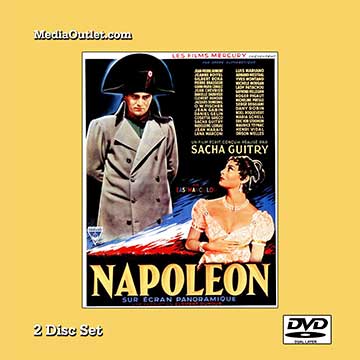
July 5, 1809: The Age Of Enlightenment
(The Enlightenment, The Age Of Reason): The Age Of Revolution: The
Atlantic Revolutions: The French Revolution: The French
Revolutionary And Napoleonic Wars (The Great French War) (The
French Revolutionary Wars, The Napoleonic Wars): The Napoleonic
Wars: The Coalition Wars: The War Of The Fifth Coalition: The
Battle Of Wagram: -- The largest battle of the Napoleonic Wars,
and indeed the largest battle in European history up to its time,
is fought between the French and Austrian Empires. The Battle Of
Wagram (Pronounced "Vagram") (5-6 July 1809) was a
military engagement of the Napoleonic Wars that ended in a costly
but decisive victory for Emperor Napoleon I's French and allied
army against the Austrian army under the command of Archduke
Charles of Austria-Teschen. The battle led to the breakup of the
Fifth Coalition, the Austrian and British-led alliance against
France. In 1809, the French military presence in Germany was
diminished as Napoleon transferred a number of soldiers to fight
in the Peninsular War. As a result, the Austrian Empire saw its
chance to recover some of its former sphere of influence and
invaded the Kingdom of Bavaria, a French ally. Recovering from his
initial surprise, Napoleon beat the Austrian forces and occupied
Vienna at the beginning of May 1809. Despite the string of sharp
defeats and the loss of the empire's capital, Archduke Charles
salvaged an army, with which he retreated north of the Danube.
This allowed the Austrians to continue the war. Towards the end of
May, Napoleon resumed the offensive, suffering a surprise defeat
at the Battle of Aspern-Essling. It took Napoleon six weeks to
prepare his next offensive, for which he amassed a 165,000-man
French, German and Italian army in the vicinity of Vienna. The
Battle Of Wagram began after Napoleon crossed the Danube with the
bulk of these forces during the night of 4 July and attacked the
145,000-man strong Austrian army. Having successfully crossed the
river, Napoleon attempted an early breakthrough and launched a
series of evening attacks against the Austrian army. The Austrians
were thinly spread in a wide semicircle, but held a naturally
strong position. After the attackers enjoyed some initial success,
the defenders regained the upper hand and the attacks failed.
Bolstered by his success, the next day at dawn Archduke Charles
launched a series of attacks along the entire battle line, seeking
to take the opposing army in a double envelopment. The offensive
failed against the French right but nearly broke Napoleon's left.
However, the Emperor countered by launching a cavalry charge,
which temporarily halted the Austrian advance. He then redeployed
IV Corps to stabilise his left, while setting up a grand battery,
which pounded the Austrian right and centre. The tide of battle
turned and the Emperor launched an offensive along the entire
line, while Marechal Louis-Nicolas Davout drove an offensive,
which turned the Austrian left, and rendered Charles's position
untenable. Towards mid-afternoon on 6 July, Charles admitted
defeat and led a retreat, frustrating enemy attempts to pursue.
After the battle, Charles remained in command of a cohesive force
and decided to retreat to Bohemia. However, the Grande Armee
eventually caught up with him and scored a victory at the Battle
of Znaim. With the battle still raging, Charles decided to ask for
an armistice, effectively ending the war. With 80,000 casualties,
the two-day Battle Of Wagram was particularly bloody, mainly due
to the use of 1,000 artillery pieces and the expenditure of over
180,000 rounds of artillery ammunition on a flat battlefield
packed with some 300,000 men. Although Napoleon was the
uncontested winner, he failed to secure an overwhelming victory
and the Austrian casualties were only slightly greater than those
of the French and allies. Nonetheless, the defeat was serious
enough to shatter the morale of the Austrians, who could no longer
find the will to continue the struggle. The resulting Treaty of
Schoenbrunn meant the loss of one sixth of the Austrian Empire's
subjects, along with some territories. On Sale Until Midnight
Tonight PT!
https://store.earthstation1.com/napoleon-1955-dvd-raymond-pellagrin-orson-welles-2-19552.html
Today's
EarthStation1.com 15% (Or More!) Off Commemorative Memorial Title:
Tank Battles: El Alamein, The Volga & Kursk + Bonus DVD MP4
Download
Today, July 5, 2026
July 5, 1943: The European Civil War:
World War II: The Second European War (The European Theater Of
World War II): The Eastern Front Of World War II: The Great
Patriotic War (The German-Soviet War): The Battle Of Kursk
(Russian: Kurskaya Bitva): Operation Citadel (German: Unternehmen
Zitadelle): -- German forces begin a massive offensive against the
Soviet Union at the Battle Of Kursk, the largest full-scale battle
in history and the world's largest tank battle, also known as
Operation Citadel. The battle broke the back of the German
Wehrmacht, and from then on, Germany's war fortunes turned against
them. The day prior, July 4, 1943, preliminary combat began in
Prokhorovka village. The fighting started on the southern face of
the salient on the evening of 4 July 1943, when German infantry
launched attacks to seize high ground for artillery observation
posts prior to the main battle that began on 5 July. During these
attacks, a number of Red Army command and observation posts along
the first main belt of defence were captured. By 16:00 on 4 July,
elements of the Panzergrenadier Division "Grossdeutschland",
3rd and 11th Panzer Divisions had seized the village of Butovo and
proceeded to capture Gertsovka before midnight. At around 22:30,
Russian General Vatutin ordered 600 guns, mortars and Katyusha
rocket launchers, of the Voronezh Front, to bombard the forward
German positions, particularly those of the II SS Panzer Corps.
The Battle Of Kursk was a Second World War engagement between
German and Soviet forces on the Eastern Front near Kursk (450
kilometres or 280 miles south-west of Moscow) in the Soviet Union,
during July and August 1943. After preliminary engagements of 4
July in and around Prokhorovka village, the main Battle Of Kursk
began with the launch of the German offensive, Operation Citadel
(German: Unternehmen Zitadelle), on 5 July, which had the
objective of pinching off the Kursk salient with attacks on the
base of the salient from north and south simultaneously. After the
German offensive stalled on the northern side of the salient, on
12 July the Soviets commenced their Kursk Strategic Offensive
Operation with the launch of Operation Kutuzov against the rear of
the German forces in the northern side. On the southern side, the
Soviets also launched powerful counterattacks the same day, one of
which led to a large armoured clash, the Battle of Prokhorovka. On
3 August, the Soviets began the second phase of the Kursk
Strategic Offensive Operation with the launch of Operation
Polkovodets Rumyantsev against the German forces in the southern
side of the Kursk salient. The battle was the final strategic
offensive that the Germans were able to launch on the Eastern
Front. Because the Allied invasion of Sicily had begun, Adolf
Hitler was forced to have troops training in France diverted to
meet the Allied threat in the Mediterranean, rather than use them
as a strategic reserve for the Eastern Front. Hitler canceled the
offensive at Kursk after only a week, in part to divert forces to
Italy, resulting in a reduction of German strength on the Eastern
Front. Germany's extensive losses of men and tanks ensured that
the victorious Soviet Red Army enjoyed the strategic initiative
for the remainder of the war. The Germans hoped to weaken the
Soviet offensive potential for the summer of 1943 by cutting off
the forces that they anticipated would be in the Kursk salient.
The Kursk salient or bulge was 250 kilometres (160 mi) long from
north to south and 160 kilometres (99 mi) from east to west. The
plan envisioned an envelopment by a pair of pincers breaking
through the northern and southern flanks of the salient. Hitler
believed that a victory here would reassert German strength and
improve his prestige with his allies, who were considering
withdrawing from the war. It was also hoped that large numbers of
Soviet prisoners would be captured to be used as slave labour in
the German armaments industry. The Soviet government had
foreknowledge of the German intentions, provided in part by the
British intelligence service's overall intelligence gatherings and
their cryptanalysis of intercepted Lorenz cipher German Army
communications, known as Tunny Intercepts, co-called because
British cryptanalysts, who referred to encrypted German
teleprinter traffic as Fish, dubbed the machine and its traffic
Tunny (meaning tunafish). Aware months in advance that the attack
would fall on the neck of the Kursk salient, the Soviets built a
defence in depth designed to wear down the German armoured
spearhead. The Germans delayed the offensive while they tried to
build up their forces and waited for new weapons, mainly the new
Panther tank but also larger numbers of the Tiger heavy tank. This
gave the Red Army time to construct a series of deep defensive
belts. The defensive preparations included minefields,
fortifications, artillery fire zones and anti-tank strong points,
which extended approximately 300 km (190 mi) in depth. Soviet
mobile formations were moved out of the salient and a large
reserve force was formed for strategic counter-offensives. The
Battle Of Kursk was the first time in the Second World War that a
German strategic offensive was halted before it could break
through enemy defences and penetrate to its strategic depths. The
maximum depth of the German advance was 8-12 kilometres (5.0-7.5
mi) in the north and 35 kilometres (22 mi) in the south. Though
the Red Army had succeeded in winter offensives previously, their
counter-offensives following the German attack at Kursk were their
first successful strategic summer offensives of the war. On Sale
Until Midnight Tonight PT!
https://store.earthstation1.com/tank-battles-el-alamein-to-the-volga-and-battle-of-kursk-dvd.html
Today's
EarthStation1.com 15% (Or More!) Off Commemorative Memorial Title:
Crusade In Europe WWII TV Series DVD, Video Download, USB Flash
Drive
Today, July 5, 2026
July 5, 1943: The European Civil War:
World War II: The Second European War (The European Theater Of
World War II): The Mediterranean And Middle East Theater Of World
War II: The Italian Campaign Of World War II (The Liberation Of
Italy): The Allied Invasion Of Sicily (The Battle Of Sicily,
Operation Husky:) -- An Allied invasion fleet secretly sails for
Sicily, ultimately to commence Operation Husky on July 10, 1943.
The Allied Invasion Of Sicily, codenamed Operation Husky, was a
major campaign of World War II, in which the Allies took the
island of Sicily from the Axis powers (Italy and Nazi Germany). It
began with a large amphibious and airborne operation, followed by
a six-week land campaign, and initiated the Italian Campaign.
Husky began on the night of 9-10 July 1943, and ended on 17
August. Strategically, Husky achieved the goals set out for it by
Allied planners; the Allies drove Axis air, land and naval forces
from the island and the Mediterranean sea lanes were opened for
Allied merchant ships for the first time since 1941. The Italian
leader, Benito Mussolini, was toppled from power in Italy and the
way was opened for the Allied invasion of Italy. The German
leader, Adolf Hitler, canceled a major offensive at Kursk after
only a week, in part to divert forces to Italy, resulting in a
reduction of German strength on the Eastern Front. The Allies had
foreknowledge of the German intentions regarding Kursk, provided
in part by the British intelligence service's overall intelligence
gatherings and their cryptanalysis of intercepted Lorenz cipher
German Army communications, known as Tunny Intercepts, co-called
because British cryptanalysts, who referred to encrypted German
teleprinter traffic as Fish, dubbed the machine and its traffic
Tunny (meaning tunafish). Aware thereby months in advance that an
attack would fall on the neck of the Kursk salient, the Allies
concluded that an invasion of Sicily, and the collapse of Italy
that might potentionally result, timed to occur at the same time
that the Germans planned to launch the Battle Of Kursk would
require German troops to be diverted from the battle to replace
the Italians in Italy and to a lesser extent the Balkans.
Accordingly, Adolf Hitler was forced to have troops training in
France to be a strategic reserve for the Eastern Front diverted to
meet the Allied threat in the Mediterranean, and one fifth of the
entire German army was diverted from the east to southern Europe,
a proportion that would remain until near the end of the war.
Germany's extensive losses of men and tanks in the Battle Of Kursk
ensured that the victorious Soviet Red Army enjoyed the strategic
initiative for the remainder of the war. On Sale Until Midnight
Tonight PT!
https://store.earthstation1.com/crusade-in-europe-2-dual-layer-dvds-tv-series-eisenhowe2.html
Today's
EarthStation1.com 15% (Or More!) Off Commemorative Memorial Title:
The Siege Of Vicksburg American Civil War DVD MP4 Download USB
Drive
Today, July 5, 2026
July 5, 1801: #BOTD: #HBD! David
Farragut, American admiral, flag officer (a commissioned officer
whose seniority entitles them to fly a flag that marks their rank)
of the United States Navy during the American Civil War, the first
rear admiral, vice admiral, and admiral in the United States Navy,
best remembered for his paraphrased order at the Battle of Mobile
Bay "Damn the torpedoes, full speed ahead" in U.S. Navy
tradition (d. August 14, 1870) is #born David Glasgow Farragut
near Knoxville, Tennessee. Farragut was fostered by naval officer
David Porter after the death of his mother. Despite his young age,
Farragut served in the War Of 1812 under the command of his
adoptive father. He received his first command in 1824 and
participated in anti-piracy operations in the Caribbean Sea. He
served in the Mexican-American War under the command of Matthew C.
Perry, participating in the blockade of Tuxpan. After the war, he
oversaw the construction of the Mare Island Naval Shipyard, the
first U.S. Navy base established on the Pacific Ocean. Though
Farragut resided in Norfolk, Virginia prior to the Civil War, he
was a Southern Unionist who strongly opposed Southern secession
and remained loyal to the Union after the outbreak of the Civil
War. Despite some doubts about Farragut's loyalty, Farragut was
assigned command of an attack on the important Confederate port
city of New Orleans. After fighting past Fort St. Philip and Fort
Jackson, Farragut captured New Orleans in April 1862. He was
promoted to rear admiral after the battle and helped extend Union
control up along the Mississippi River, participating in the Siege
Of Port Hudson. With the Union in control of the Mississippi,
Farragut led a successful attack on Mobile Bay, home to the last
major Confederate port on the Gulf of Mexico. Farragut was
promoted to admiral following the end of the Civil War and
remained on active duty until he died of a heart attack at the age
of 69 in Portsmouth, New Hampshire. He had served almost sixty
years in the navy. He is interred at Woodlawn Cemetery, in The
Bronx, New York City. His gravesite is listed on the National
Register of Historic Places, as is Woodlawn Cemetery itself. On
Sale Until Midnight Tonight PT!
https://store.earthstation1.com/the-siege-of-vicksburg-american-civil-war-dvd-mp4-download-usb-driv4.html
Today's
EarthStation1.com 15% (Or More!) Off Commemorative Memorial Title:
Charles Darwin: The Devil's Chaplain + Bonus Title Video Download
DVD
Today, July 5, 2026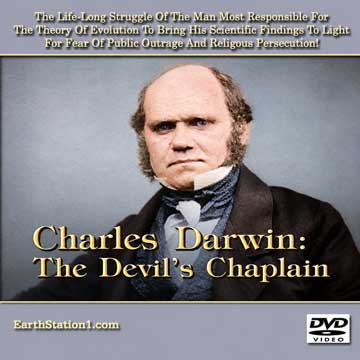
July 5, 1805: #BOTD: #HBD! Robert
FitzRoy, English admiral of the Royal Navy, scientist, politician
and pioneering meteorologist who made accurate daily weather
predictions, which he called by a new name of his own invention:
"forecasts", 2nd Governor of New Zealand who achieved
lasting fame as the captain of HMS Beagle during Charles Darwin's
famous voyage, FitzRoy's second expedition to Tierra del Fuego and
the Southern Cone (d. April 30, 1865) is #born at Ampton Hall,
Ampton, Suffolk, England, into the upper echelons of the British
aristocracy and a tradition of public service. Vice-Admiral Robert
FitzRoy FRS FitzRoy in 1854 established what would later be called
the Met Office, and created systems to get weather information to
sailors and fishermen for their safety. He was an able surveyor
and hydrographer. As Governor of New Zealand, serving from 1843 to
1845, he tried to protect the Maori from illegal land sales
claimed by British settlers. FitzRoy had been promoted to
rear-admiral on the reserved list in 1857 and was advanced to
vice-admiral in 1863. In the coming years, internal and external
troubles at the Meteorological Office, financial concerns as well
as failing health, and his struggle with depression took their
toll. On April 30, 1865 Vice-Admiral FitzRoy died by suicide by
cutting his throat with a razor. FitzRoy died having exhausted his
entire fortune (6,000 Pounds Sterling, the equivalent of 400,000
Pounds Sterling today) on public expenditure. When this came to
light, in order to prevent his wife and daughter living in
destitution, his friend and colleague Bartholomew Sulivan began an
Admiral FitzRoy Testimonial Fund, which succeeded in getting the
government to pay back 3,000 Pounds Sterling of this sum. (Charles
Darwin contributed 100 Pounds Sterling). Queen Victoria gave the
special favour of allowing his widow and daughter the use of grace
and favour apartments at Hampton Court Palace. FitzRoy is buried
in the front churchyard of All Saints' Church in Upper Norwood,
south London. His memorial was restored by the Meteorological
Office in 1981. On Sale Until Midnight Tonight PT!
https://store.earthstation1.com/charles-darwin-the-devil39s-chaplain-theory-of-evolution-sa39.html
Today's
EarthStation1.com 15% (Or More!) Off Commemorative Memorial Title:
Horatio Hornblower Radio Series Michael Redgrave MP3s, CD, USB
Drive
Today, July 5, 2026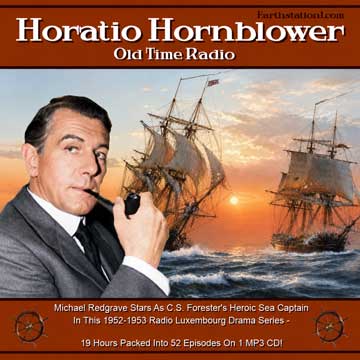
July 5, 1819: #DOTD: #RIP: Admiral Of The
Red Sir William Cornwallis, GCB, English admiral and politician
(b. February 10, 1744) #dies at the Newlands estate (now known as
Newlands Manor) in Milford on Sea in Hampshire, South East
England, aged 75. According to his biographer George Cornwallis
West, the Admiral had left instructions that he was to be 'buried
at Milford near Captain Whitby' also that no tomb-stone or any
kind of memorial was to be erected in his memory. This last
injunction Mrs Whitby obeyed to the letter. However, Mrs Whitby's
daughter, Theresa West, erected a memorial in the church to the
Admiral and her parents and the inscription confirms that all
three were "in the same vault at the western end of this
churchyard". So to find the Admiral's grave it was necessary
to find Captain Whitby's grave. The general area was known
although the grave was not immediately identifiable. Towards the
end of 2013, The Milford On Sea Historical Record Society (MOSHRS)
received three files of material from a former Hon Sec of the
Society in the 1970s. Included was a transcription of Mrs West's
memorial and also a transcription of what was said to be the
original wording on Captain Whitby's grave. There were some
additional notes "Adm Man died 1813.... the position of his
grave next to Capt Whitby but now beneath the vestry". The
graveyard survey of 1922 shows Admiral Man at B28A and B29 as
"Whitby, John (Cresswell Hall) b1784 d1793 or 1800".
Early in 2014 one of the members of the Society chanced to look at
the ledger on the grave outside the vestry door. Despite the
wording being very worn, the low sun caught it at just the right
angle and some of the wording could be made out. After researching
safe methods of highlighting the inscription on the ledger, the
first of which was inconclusive, the inscription was finally
revealed: " ========= In Memory of JOHN WHITBY Esq Son of the
Rev THOs WHITBY of Cresswell Hall STAFFORDSHIRE [Born 7th October
1774] He was promoted to the Rank of POST CAPTAIN in His MAJESTIES
NAVY [on the 29 April 1793] and departed this life on the 7th of
April 1806 (Note: The parts in square brackets are indistinct and
taken from the transcript) ========= The Admiral's grave had been
found. In May 2014 it was proposed that MOSHRS together with The
1805 Club, and with church agreement, should erect some form of
identification for the Admiral's grave. MOSHRS members were
informed in Spring 2015 about a proposal to conserve the
Cornwallis/Whitby grave ledger and repair the memorial to Rear
Admiral John Peyton who served at the same time as Cornwallis;
re-siting the memorial when it was returned from repair. Faculty
approval from the church had been received in autumn 2016 and
permission to proceed was received in March 2017. Donations were
sought to support this work. Further research into the careers of
Cornwallis and Whitby caused the Society to realise that there was
a very important story to be told about the achievements of
Admiral Cornwallis. This in turn led to the determination to
prepare a commemoration of Cornwallis on the 200th anniversary of
his death - and so "Cornwallis Remembered 1819-2019" was
born. William Cornwallis was born in Suffolk, East Anglia,
England. He was a Royal Navy officer who was the brother of
Charles Cornwallis, the 1st Marquess Cornwallis, British commander
at the Siege Of Yorktown. Cornwallis took part in a number of
decisive battles including the Siege of Louisbourg in 1758 and the
Battle of the Saintes but is best known as a friend of Lord Nelson
and as the commander-in-chief of the Channel Fleet during the
Napoleonic Wars. He is depicted in the Horatio Hornblower novel,
Hornblower and the Hotspur, by C. S. Forester, which was made into
the 1952-1953 Radio Luxembourg radio drama series. On Sale Until
Midnight Tonight PT!
https://store.earthstation1.com/horatio-hornblower-mp3-cd-complete-radio-adventure-serie3.html
Today's
EarthStation1.com 15% (Or More!) Off Commemorative Memorial Title:
That War In Korea 1964 TV Feature Film Documentary DVD, Download,
USB
Today, July 5, 2026
July 5, 1950: Korea: The History Of
Korea: The Aftermath Of World War II: The Cold War: The Korean
Conflict: The Korean War: The Battle Of Osan: Task Force Smith: --
American and North Korean forces first clash, a battle in which
the American forces made a shockingly poor account of their
planning, their tactics, their equipment, and themselves. Task
Force Smith consisted of 400 infantry troops supported by an
artillery battery. The task force lacked both anti-tank guns and
effective infantry anti-tank weapons, having been equipped with
obsolescent World War II era 2.36-in. rocket launchers
("bazookas") and a few 57 mm recoilless rifles. Aside
from a limited number of HEAT shells for the unit's 105-mm
howitzers, crew-served weapons capable of defeating the T-34
Soviet tank had not been distributed to U.S. Army forces in Korea.
So ill-equpped, and after having had years of soft discipline that
left these forces virtually unprepared for the eventuality of an
immediate and hardcore military conflict, Task Force Smith was
hurriedly rushed to Osan, south of the South Korean capital Seoul,
and ordered to fight a rearguard action in order to delay
advancing North Korean forces, while additional U.S. troops
arrived in the country to form a stronger defensive line to the
south. A North Korean tank column, equipped with ex-Soviet T-34/85
tanks, overran the task force in the first encounter and continued
its advance south. After the North Korean tank column had breached
U.S. lines, Task Force Smith opened fire on a force of some 5,000
North Korean infantry approaching its position; while this did
temporarily hold up the North Korean advance, North Korean troops
eventually outflanked and overwhelmed American positions, and the
remnants of Task Force Smith went into a full, disorderly and
embarrasingly disgraceful retreat. On Sale Until Midnight Tonight
PT!
https://store.earthstation1.com/that-war-in-korea-tv-documentary-feature-film-dvd.html
Today's
EarthStation1.com 15% (Or More!) Off Commemorative Memorial Title:
Korea: The Unknown War TV Korean War Series DVD, Download, USB
Drive
Today, July 5, 2026
July 5, 1912: #BOTD: #HBD!: Frank Pace,
3rd United States Secretary of the Army from April 12, 1950 to
January 20, 1953, CEO of General Dynamics Corporation from 1953
until 1962, member of the Eisenhower Ten, first chairman of the
Corporation for Public Broadcasting from 1968 until 1972 (d.
January 8, 1988) is #born Frank Pace Jr. in Little Rock, Arkansas.
He attended The Hill School, Pottstown, Pennsylvania. In 1933 he
graduated from Princeton University, and in 1936 from Harvard Law
School. Pace entered public service in 1936 as an assistant
district attorney in Arkansas. He moved onto the Arkansas Revenue
Department in 1938. In 1942 he was commissioned into the United
States Army Air Forces as a second lieutenant where he served
until 1945 in the Air Transport Command, Army Air Corps, reaching
the rank of Major. After leaving the Army in 1945 he returned to
public service as an assistant to the United States Attorney
General, then later as executive assistant to the Postmaster
General. He then moved in 1948 to the Bureau of the Budget, first
as assistant director and then as director. On April 12, 1950 he
was appointed Secretary of the Army, where he served until January
20, 1953. In August 1950, to avert a threatened strike during the
Korean War, President Truman ordered Pace to seize control of the
nation's railroads. He went on to serve as chief executive officer
of General Dynamics Corporation from 1953 until 1962. He was
selected as the administrator-designate of the Emergency Transport
Agency; part of a secret group created by President Eisenhower in
1958 that would serve in the event of a national emergency that
became known as the Eisenhower Ten. Pace appeared on the cover of
Time magazine on January 20, 1958. In 1964, Pace joined David
Rockefeller to launch the International Executive Service Corps,
which was established to help bring about prosperity and stability
in developing nations through the growth of private enterprise.
Pace went on to serve as president of the IESC. Pace was the first
chairman of the Corporation for Public Broadcasting, from 1968
until 1972. In the early 1970s he worked for the first Executive
Service Corps (ESC) as a Management Support Organization (MSO) in
New York. Pace died of a heart attack in Greenwich, Connecticut on
January 8, 1988, at the age of 75. His burial details are not
publicly disclosed. On Sale Until Midnight Tonight PT!
https://store.earthstation1.com/korea-the-unknown-war-dvd-complete-6-part-tv-series-3-dis63.html
Today's
EarthStation1.com 15% (Or More!) Off Commemorative Memorial Title:
Battleline (1963) WWII TV Documentary Series DVD, Download, USB
Drive
Today, July 5, 2026
July 5, 1945: World War II: The Pacific
War (The Asia-Pacific War, The Pacific Theater Of World War II):
The Battle Of The Philippines: World War II: The Pacific War (The
Asia-Pacific War, The Pacific Theater Of World War II): The
Pacific Ocean Theater Of World War II: The Southwest Pacific
Theater Of World War II: The Philippines Campaign (1944-1945)
(Battle Of The Philippines, Second Philippines Campaign, The
Liberation Of The Philippines, Operation Musketeer I, II, and
III): -- The Liberation Of The Philippines is declared; however,
Japanese combat operations continue past this point; when Japanese
forces were ordered to surrender by Tokyo on August 15, 1945,
after the dropping of the atomic bombs on mainland Japan and the
Soviet Invasion Of Manchuria, the fighting still continued, it
only ceased after the formal signing of the surrender of Imperial
Japan on September 2, 1945. The Philippines Campaign, also known
as the Battle Of The Philippines or The Liberation Of The
Philippines (Filipino: Kampanya sa Pilipinas, Labanan sa Pilipinas
and Liberasyon ng Pilipinas), (Operation Musketeer I, II, and III)
(Filipino: Operasyon Mosketero I, II, at III), was the American
and Filipino campaign to defeat and expel the Imperial Japanese
forces occupying the Philippines during World War II. The Japanese
Army overran all of the Philippines during the first half of 1942.
The Liberation Of The Philippines commenced with amphibious
landings on the eastern Philippine island of Leyte on October 20,
1944. United States and Philippine Commonwealth military forces
were progressing in liberating territory and islands when the
Japanese forces in the Philippines were ordered to surrender by
Tokyo on August 15, 1945, after the dropping of the atomic bombs
on mainland Japan and the Soviet Invasion Of Manchuria. On Sale
Until Midnight Tonight PT!
https://store.earthstation1.com/battleline-wwii-tv-documentary-series-5-dual-layer-dvd5.html
Today's
EarthStation1.com 15% (Or More!) Off Commemorative Memorial Title:
France: Conquest To Liberation In World War II MP4 Video Download
DVD
Today, July 5, 2026
July 5, 1940: The European Civil War:
World War II: The Second European War (The European Theater Of
World War II): The Battle Of France (The Western Campaign [German:
Westfeldzug], The French Campaign [German: Frankreichfeldzug;
French: Campagne De France], The Fall Of France): Fall Rot
(German: "Case Red"): Vichy France (The French State):
-- The Vichy France government breaks off diplomatic relations
with The United Kingdom; however, diplomatic relations with Canada
were maintained until the occupation of Southern France (Case
Anton) by Germany and Italy in November 1942. Two days prior, on
July 3, 1940, the Attack On Mers-el-Kebir took place. To stop
ships from falling into German hands the French fleet of the
Atlantic based at Mers El Kebir, was bombarded by the British
fleet, coming from Gibraltar, causing the loss of three
battleships: Dunkerque, Provence and French battleship Bretagne.
One thousand two hundred sailors perished. Frenchmen worldwide
were shocked by the event, despite those sympathetic to or
collaborating with the Allies recognizing the military necessity
of the act. On Sale Until Midnight Tonight PT!
https://store.earthstation1.com/france-conquest-to-liberation-occupied-and-vichy-wwii.html
Today's
EarthStation1.com 15% (Or More!) Off Commemorative Memorial Title:
Labor Union Films Collection DVD, Video Download, USB Flash Drive
Today, July 5, 2026
July 5, 1934: Labor Union Disputes (Trade Union Disputes): Strikes (Strike Actions, Labor Strikes, Labour Strikes): Armed Conflicts In American Labor Union History: The 1934 West Coast Waterfront Strike (The 1934 West Coast Longshoremen's Strike): Bloody Thursday: -- Police open fire on striking longshoremen in San Francisco. The 1934 West Coast Waterfront Strike (also known as the 1934 West Coast Longshoremen's Strike, as well as a number of variations on these names) lasted eighty-three days, and began on May 9, 1934 when longshoremen in every West Coast port walked out. The strike peaked with "Bloody Thursday" and the San Francisco General Strike when all work stopped in the major port city for four days and led ultimately to the settlement of the West Coast Longshoremen's Strike. The result of the strike was the unionization of all of the West Coast ports of the United States. The San Francisco General Strike of 1934, along with the Toledo Auto-Lite Strike of 1934 led by the American Workers Party and the Minneapolis Teamsters Strike of 1934 led by the Communist League of America, were important catalysts for the rise of industrial unionism in the 1930s, much of which was organized through the Congress of Industrial Organizations. After a quiet Fourth of July, the Industrial Association, the Port of San Francisco's employers' organization, tried to open up the port on Thursday, July 5. As spectators watched from Rincon Hill, the police shot tear gas canisters into the crowd, then followed with a charge by mounted police. Picketers threw the canisters and rocks back at the police, who charged again, sending the picketers into retreat. Each side then refortified and took stock. The events took a violent turn that afternoon, as hostilities resumed outside of the ILA strike kitchen. Eyewitness accounts differ on the exact events that transpired next. According to some witnesses, a group of strikers first surrounded a police car and attempted to tip it over, prompting the police to fire shotguns in the air, and then revolvers at the crowd. Other eyewitness accounts claim that police officers started shooting in the direction of the strikers, provoking strikers to defend themselves. Policemen fired a shotgun into the crowd, striking three men in intersection of Steuart and Mission streets. One of the men, Howard Sperry, a striking longshoreman, later died of his wounds. Another man, Charles Olsen, was also shot but later recovered from his wounds. A third man, Nick Bordoise - a Greek by birth (originally named Nick Counderakis) who was an out of work member of the cook's union volunteering at the ILA strike kitchen - was shot but managed to make his way around the corner onto Spear Street, where he was found several hours later. Like Sperry, he died at the hospital. Strikers immediately cordoned off the area where the two picketers had been shot, laying flowers and wreaths around it. Police arrived to remove the flowers and drive off the picketers minutes later. Once the police left, the strikers returned, replaced the flowers and stood guard over the spot. Though Sperry and Bordoise had been shot several blocks apart, this spot became synonymous with the memory of the two slain men and "Bloody Thursday.". As strikers carried wounded picketers into the ILA union hall police fired on the hall and lobbed tear gas canisters at nearby hotels. At this point someone reportedly called the union hall to ask "Are you willing to arbitrate now?". Under orders from California Governor Frank Merriam, the California National Guard moved in that evening to patrol the waterfront. Similarly, federal soldiers of the United States Army stationed at the Presidio were placed on alert. The picketers pulled back, unwilling to take on armed soldiers in an uneven fight, and trucks and trains began moving without interference. Bridges asked the San Francisco Labor Council to meet that Saturday, July 7, to authorize a general strike. The Alameda County Central Labor Council in Oakland considered the same action. Teamsters in both San Francisco and Oakland voted to strike, over the objections of their leaders, on Sunday, July 8. The following day, several thousand strikers, families and sympathizers took part in a funeral procession down Market Street, stretching more than a mile and a half, for Nicholas Bordois and Howard Sperry, the two persons killed on "Bloody Thursday". The police were wholly absent from the scene. The march made an enormous impact on San Franciscans, making a general strike, which had formerly been "the visionary dream of a small group of the most radical workers, became . . . a practical and realizable objective." After dozens of Bay Area unions voted for a general strike over the next few days, the San Francisco Labor Council voted on July 14 to call a general strike. The Teamsters had already been out for two days by that point. San Francisco Mayor Angelo Rossi declared a state of emergency. Some federal officials, particularly Secretary Of Labor Frances Perkins, were more skeptical. Roosevelt later recalled that some persons were urging him to steer the USS Houston, which was carrying him to Hawaii, "into San Francisco Bay, all flags flying and guns double-shotted, and end the strike." Roosevelt rejected the suggestion. The general strike began on the 16th, involving some 150,000 workers. On the 17th the police arrested more than 300 "radicals, subversives, and communists" while systematically smashing furniture and equipment of organizations related to the strike; the same day, General Hugh S. Johnson as head of the National Recovery Administration spoke at UC Berkeley to denounce the general strike as "a menace to the government." The strike lasted four days. Non-union truck drivers joined the first day; the movie theaters and night clubs closed down. While food deliveries continued with the permission of the strike committee, many small businesses closed, posting signs in support of the strikers. On Sale Until Midnight Tonight PT! https://store.earthstation1.com/labor-union-films-dvd.html
Today's
EarthStation1.com 15% (Or More!) Off Commemorative Memorial Title:
The Great Depression 7 Part Documentary Series MP4 Video Download
DVD
Today, July 5, 2026
July 5, 1935: Organized Labor: The Labor Union Movement: The Labor History Of The United States: Labor Unions In The United States: Trade Union Legislation: The National Labor Relations Act Of 1935 (The Wagner Act): -- The National Labor Relations Act, which governs labor relations in the United States, is signed into law by President Franklin D. Roosevelt. The National Labor Relations Act of 1935, also known as the Wagner Act after New York Senator Robert F. Wagner, is a foundational statute of United States labor law which guarantees basic rights of private sector employees to organize into trade unions, engage in collective bargaining for better terms and conditions at work, and take collective action including strike if necessary. The act also created the National Labor Relations Board, which conducts elections that can expect employers to engage in collective bargaining with labor unions (also known as trade unions). The Act does not apply to workers who are covered by the Railway Labor Act, agricultural employees, domestic employees, supervisors, federal, state or local government workers, independent contractors and some close relatives of individual employers. On Sale Until Midnight Tonight PT! https://store.earthstation1.com/grde7padosem.html
Today's
EarthStation1.com 15% (Or More!) Off Commemorative Memorial Title:
High Crimes And Misdemeanors: The Iran-Contra Scandal DVD, MP4,
USB
Today, July 5, 2026
July 5, 1989: Scandals: Political
Scandals: Political Scandals Of The United States: The Aftermath
Of World War II: The Cold War: The Iran-Iraq War: Iran-United
States Relations: The Iran-Contra Affair (The Iran-Contra Scandal
): -- Oliver North is sentenced by U.S. District Judge Gerhard A.
Gesell to a three-year suspended prison term, two years probation,
150K USD in fines and 1,200 hours community service. His
convictions are later overturned. The Iran-Contra Affair, also
referred to as Irangate, Contragate or the Iran-Contra scandal,
was a political scandal in the United States that occurred during
the second term of the Reagan Administration. Senior
administration officials secretly facilitated the sale of arms to
Iran, which was the subject of an arms embargo. They hoped,
thereby, to fund the Contras in Nicaragua while at the same time
negotiating the release of several U.S. hostages. Under the Boland
Amendment, further funding of the Contras by the government had
been prohibited by Congress. On Sale Until Midnight Tonight PT!
https://store.earthstation1.com/high-crimes-and-misdemeanors-the-ironcontra-scandal-dvd.html
Today's
EarthStation1.com 15% (Or More!) Off Commemorative Memorial Title:
The Secret Of The Templars Series + Bonus Title MP4 Video Download
DVD
Today, July 5, 2026
July 5, 1889: #BOTD: Jean Cocteau, French novelist, poet, playwright, novelist, designer, artist, filmmaker, visual artist. critic, Rosicrucian, and enormous moral disappointment (d. October 11, 1963) is #born Jean Maurice Eugene Clement Cocteau in Maisons-Laffitte, Yvelines, a town near Paris, to Georges Cocteau and his wife, Eugenie Lecomte: a socially prominent Parisian family. Jean Cocteau insisted on calling himself a poet, classifying the great variety of his works - poems, novels, plays, essays, drawings, films - as "poesie", "poesie de roman", "poesie de theatre", "poesie critique", "poesie graphique" and "poesie cinematographique". He is best known for his novels Le Grand Ecart (1923), Le Livre Blanc (1928), and Les Enfants Terribles (1929); the stage plays La Voix Humaine (1930), La Machine Infernale (1934), Les Parents terribles (1938), La Machine a ecrire (1941), and L'Aigle a deux tetes (1946); and the films The Blood of a Poet (1930), Les Parents Terribles (1948), Beauty and the Beast (1946), Orpheus (1949), and Testament of Orpheus (1960), which alongside Blood of a Poet and Orpheus constitute the so-called Orphic Trilogy. He was described as "one of avant-garde's most successful and influential filmmakers" by AllMovie. Cocteau was born in Maisons-Laffitte, Yvelines, a town near Paris, to Georges Cocteau and his wife, Eugenie Lecomte; a socially prominent Parisian family. His father was a lawyer and amateur painter, who committed suicide when Cocteau was nine. From 1900-1904, Cocteau attended the Lycee Condorcet where he met and began a relationship with schoolmate Pierre Dargelos, who would later reappear throughout Cocteau's oeuvre. He left home at fifteen. He published his first volume of poems, Aladdin's Lamp, at nineteen. Cocteau soon became known in Bohemian artistic circles as The Frivolous Prince, the title of a volume he published at twenty-two. Edith Wharton described him as a man "to whom every great line of poetry was a sunrise, every sunset the foundation of the Heavenly City..." In his early twenties, Cocteau became associated with the writers Marcel Proust, Andre Gide, and Maurice Barres. In 1912, he collaborated with Leon Bakst on Le Dieu bleu for the Ballets Russes; the principal dancers being Tamara Karsavina and Vaslav Nijinsky. During World War I Cocteau served in the Red Cross as an ambulance driver. This was the period in which he met the poet Guillaume Apollinaire, artists Pablo Picasso and Amedeo Modigliani, and numerous other writers and artists with whom he later collaborated. Russian impresario Sergei Diaghilev persuaded Cocteau to write a scenario for a ballet, which resulted in Parade in 1917. It was produced by Diaghilev, with sets by Picasso, the libretto by Apollinaire and the music by Erik Satie. The piece was later expanded into a full opera, with music by Satie, Francis Poulenc and Maurice Ravel. "If it had not been for Apollinaire in uniform," wrote Cocteau, "with his skull shaved, the scar on his temple and the bandage around his head, women would have gouged our eyes out with hairpins." He denied being a Surrealist or being in any way attached to the movement. An important exponent of avant-garde art, Cocteau had great influence on the work of others, including a group of composers known as Les six. In the early twenties, he and other members of Les six frequented a wildly popular bar named Le Boeuf sur le Toit, a name that Cocteau himself had a hand in picking. The popularity was due in no small measure to the presence of Cocteau and his friends. In 1918 he met the French poet Raymond Radiguet. They collaborated extensively, socialized, and undertook many journeys and vacations together. Cocteau also got Radiguet exempted from military service. Admiring of Radiguet's great literary talent, Cocteau promoted his friend's works in his artistic circle and arranged for the publication by Grasset of Le Diable au corps (a largely autobiographical story of an adulterous relationship between a married woman and a younger man), exerting his influence to have the novel awarded the "Nouveau Monde" literary prize. Some contemporaries and later commentators thought there might have been a romantic component to their friendship. Cocteau himself was aware of this perception, and worked earnestly to dispel the notion that their relationship was sexual in nature. There is disagreement over Cocteau's reaction to Radiguet's sudden death in 1923, with some claiming that it left him stunned, despondent and prey to opium addiction. Opponents of that interpretation point out that he did not attend the funeral (he generally did not attend funerals) and immediately left Paris with Diaghilev for a performance of Les noces (The Wedding) by the Ballets Russes at Monte Carlo. Cocteau himself much later characterised his reaction as one of "stupor and disgust." His opium addiction at the time, Cocteau said, was only coincidental, due to a chance meeting with Louis Laloy, the administrator of the Monte Carlo Opera. Cocteau's opium use and his efforts to stop profoundly changed his literary style. His most notable book, Les Enfants Terribles, was written in a week during a strenuous opium weaning. In Opium: Journal of drug rehabilitation , he recounts the experience of his recovery from opium addiction in 1929. His account, which includes vivid pen-and-ink illustrations, alternates between his moment-to-moment experiences of drug withdrawal and his current thoughts about people and events in his world. Cocteau was supported throughout his recovery by his friend and correspondent, Catholic philosopher Jacques Maritain. Under Maritain's influence Cocteau made a temporary return to the sacraments of the Catholic Church. He again returned to the Church later in life and undertook a number of religious art projects. On June 15, 1926 Cocteau's play Orphee was staged in Paris. It was quickly followed by an exhibition of drawings and "constructions" called Poesie plastique-objets, dessins. Cocteau wrote the libretto for Igor Stravinsky's opera-oratorio Oedipus rex, which had its original performance in the Theatre Sarah Bernhardt in Paris on 30 May 1927. In 1929 one of his most celebrated and well known works, the novel Les Enfants terribles was published. In 1930 Cocteau made his first film The Blood of a Poet, publicly shown in 1932. Though now generally accepted as a surrealist film, the surrealists themselves did not accept it as a truly surrealist work. Although one of Cocteau's best known works the 1930's is notable rather for a number of stage plays. Most notably La Voix humaine and Les Parents terribles, which was a popular success. His 1934 play La Machine infernal was Cocteau's stage version of the Oedipus legend and is considered to be his greatest work for the theater. During this period Cocteau also published two volumes of journalism, including Mon Premier Voyage: Tour du Monde en 80 jours, a neo-Jules Verne around the world travel reportage he made for the newspaper Paris-Soir. Biographer James S. Williams describes Cocteau's politics as "naturally Right-leaning." During the Nazi occupation of France, he was in a "round-table" of French and German intellectuals who met at the Georges V Hotel in Paris, including Cocteau, the writers Ernst Junger, Paul Morand and Henry Millon de Montherlant, the publisher Gaston Gallimard and the Nazi legal scholar Carl Schmitt. His friend Arno Breker convinced him that Adolf Hitler was a pacifist and patron of the arts with France's best interests in mind. In his diary, Cocteau accused France of disrespect towards Hitler and speculated on the Fuhrer's sexuality. Cocteau effusively praised Breker's sculptures in an article entitled 'Salut a Breker' published in 1942. This piece caused him to be arraigned on charges of collaboration after the war, though he was cleared of any wrongdoing and had used his contacts to his failed attempt to save friends such as Max Jacob. In 1940, Le Bel Indifferent, Cocteau's play written for and starring Edith Piaf, was enormously successful. Cocteau's later years is mostly associated with his films. Cocteau's films, most of which he both wrote and directed, were particularly important in introducing the avant-garde into French cinema and influenced to a certain degree the upcoming French New Wave genre. Following The Blood of a Poet (1930), his best known films include Beauty and the Beast (1946), Les Parents terribles (1948), and Orpheus (1949). His final film, Le Testament d'Orphee (The Testament of Orpheus) (1960), featured appearances by Picasso and matador Luis Miguel Dominguin, along with Yul Brynner, who also helped finance the film. In 1945 Cocteau was one of several designers who created sets for the Theatre de la Mode. He drew inspiration from filmmaker Rene Clair while making Tribute to Rene Clair: I Married a Witch. The maquette is described in his "Journal 1942-1945," in his entry for 12 February 1945: "I saw the model of my set. Fashion bores me, but I am amused by the set and fashion placed together. It is a smoldering maid's room. One discovers an aerial view of Paris through the wall and ceiling holes. It creates vertigo. On the iron bed lies a fainted bride. Behind her stand several dismayed ladies. On the right, a very elegant lady washes her hands in a flophouse basin. Through the unhinged door on the left, a lady enters with raised arms. Others are pushed against the walls. The vision provoking this catastrophe is a bride-witch astride a broom, flying through the ceiling, her hair and train streaming." In 1956 Cocteau decorated the Chapelle Saint-Pierre in Villefranche-sur-Mer with mural paintings. The following year he also decorated the marriage hall at the Hotel de Ville in Menton. Jean Cocteau never hid his homosexuality. He was the author of the mildly homoerotic and semi-autobiographical Le livre blanc (translated as The White Paper or The White Book), published anonymously in 1928. He never repudiated its authorship and a later edition of the novel features his foreword and drawings. The novel begins: "As far back as I can remember, and even at an age when the mind does not yet influence the senses, I find traces of my love of boys. I have always loved the strong sex that I find legitimate to call the fair sex. My misfortunes came from a society that condemns the rare as a crime and forces us to reform our inclinations." Frequently his work, either literary (Les enfants terribles), graphic (erotic drawings, book illustration, paintings) or cinematographic (The Blood of a Poet, Orpheus, Beauty and the Beast), is pervaded with homosexual undertones, homoerotic imagery/symbolism or outright camp. In 1947 Paul Morihien published a clandestine edition of Querelle de Brest by Jean Genet, featuring 29 very explicit erotic drawings by Cocteau. In recent years several albums of Cocteau's homoerotica have been available to the general public. It is widely believed that Cocteau had affairs with Raymond Radiguet, Jean Desbordes, Marcel Khill, and Panama Al Brown. In the 1930s, Cocteau is rumoured to have had a very brief affair with Princess Natalie Paley, the daughter of a Romanov Grand Duke and herself a sometime actress, model, and former wife of couturier Lucien Lelong. Cocteau's longest-lasting relationships were with French actors Jean Marais and Edouard Dermit, whom Cocteau formally adopted. Cocteau cast Marais in The Eternal Return (1943), Beauty and the Beast (1946), Ruy Blas (1947), and Orpheus (1949). Cocteau died of a heart attack at his chateau in Milly-la-Foret, Essonne, France, on October 11, 1963 at the age of 74. His friend, French singer Edith Piaf, died the day before but that was announced on the morning of Cocteau's day of death; it has been said that his heart failed upon hearing of Piaf's death. Actually, according to author Roger Peyrefitte, since early that year Cocteau had been devastated after a breach with his longtime friend and extremely wealthy and generous patroness Francine Weisweiller: since 1960 she was having an affair with a minor writer, which cooled her off towards Cocteau. He had a very severe heart attack on April 22. According to his wishes Cocteau is buried beneath the floor of the Chapelle Saint-Blaise des Simples in Milly-la-Foret. The epitaph on his gravestone set in the floor of the chapel reads: "I stay with you" ("Je reste avec vous"). In 1955, Cocteau was made a member of the Academie francaise and The Royal Academy of Belgium. During his life, Cocteau was commander of the Legion of Honor, Member of the Mallarme Academy, German Academy (Berlin), American Academy, Mark Twain (U.S.A) Academy, Honorary President of the Cannes Film Festival, Honorary President of the France-Hungary Association and President of the Jazz Academy and of the Academy of the Disc. Throughout his life, Cocteau tried to maintain a distance from political movements, confessing to a friend that "my politics are non-existent." According to Claude Arnaud, from the 1920s on, Cocteau's only deeply held political convictions were a marked pacifism and antiracism. He praised the French republic for serving as a haven for the persecuted, and applauded Picasso's anti-war painting Guernica as a cross that "Franco would always carry on his shoulder." In 1940, Cocteau signed a petition circulated by the Ligue internationale contre l'antisemitisme which protested the rise of racism and antisemitism in France, and declared himself "ashamed of his white skin" after witnessing the plight of colonized peoples during his travels. Although in 1938 Cocteau had compared Adolf Hitler to an evil demiurge who wished to perpetrate a Saint Bartholomew's Day massacre against Jews, his friend Arno Breker convinced him that Hitler was a pacifist and patron of the arts with France's best interests in mind. During the Nazi occupation of France, he was in a "round-table" of French and German intellectuals who met at the Georges V Hotel in Paris, including Cocteau, the writers Ernst Junger, Paul Morand and Henry Millon de Montherlant, the publisher Gaston Gallimard and the Nazi legal scholar Carl Schmitt. In his diary, Cocteau accused France of disrespect towards Hitler and speculated on the Fuhrer's sexuality. Cocteau effusively praised Breker's sculptures in an article entitled 'Salut a Breker' published in 1942. This piece caused him to be arraigned on charges of collaboration after the war, though he was cleared of any wrongdoing and had used his contacts to his failed attempt to save friends such as Max Jacob. Later, after growing closer with communists such as Louis Aragon, Cocteau would name Joseph Stalin as "the only great politician of the era." In 1940, Le Bel Indifferent, Cocteau's play written for and starring Edith Piaf (who died the day before Cocteau), was enormously successful. On Sale Until Midnight Tonight PT! https://store.earthstation1.com/seofteseboti.html
Today's
EarthStation1.com 15% (Or More!) Off Commemorative Memorial Title:
Barnum's Big Top: P. T. Barnum's Circuses + 2 Bonuses MP4 Download
DVD
Today, July 5, 2026
July 5, 1810: #BOTD: #HBD! P. T. Barnum,
American showman, author, publisher, philanthropist, politician
and businessman remembered for promoting celebrated hoaxes and for
founding the Barnum and Bailey Circus (d. April 7, 1891) is #born
Phineas Taylor Barnum in Bethel, Connecticut. P. T. Barnum said of
himself, "I am a showman by profession...and all the gilding
shall make nothing else of me," and his personal aim was "to
put money in his own coffers." Barnum is widely, but
erroneously, credited with coining the phrase "There's a
sucker born every minute." Born in Bethel, Connecticut,
Barnum became a small-business owner in his early twenties and
founded a weekly newspaper, before moving to New York City in
1834. He embarked on an entertainment career, first with a variety
troupe called "Barnum's Grand Scientific and Musical
Theater", and soon after by purchasing Scudder's American
Museum, which he renamed after himself. Barnum used the museum as
a platform to promote hoaxes and human curiosities such as the
Feejee mermaid and General Tom Thumb. In 1850 he promoted the
American tour of singer Jenny Lind, paying her an unprecedented 1K
USD a night for 150 nights. After economic reversals due to bad
investments in the 1850s, and years of litigation and public
humiliation, he used a lecture tour, mostly as a temperance
speaker, to emerge from debt. His museum added America's first
aquarium and expanded the wax-figure department. While in New
York, he converted to Universalism and was a member of the Church
of the Divine Paternity, now the Fourth Universalist Society in
the City of New York. Barnum served two terms in the Connecticut
legislature in 1865 as a Republican for Fairfield. With the
ratification of the Thirteenth Amendment to the United States
Constitution over slavery and African American suffrage, Barnum
spoke before the legislature and said, "A human soul, 'that
God has created and Christ died for,' is not to be trifled with.
It may tenant the body of a Chinaman, a Turk, an Arab, or a
Hottentot - it is still an immortal spirit". Elected in 1875
as Mayor of Bridgeport, Connecticut, he worked to improve the
water supply, bring gas lighting to streets, and enforce liquor
and prostitution laws. Barnum was instrumental in starting
Bridgeport Hospital, founded in 1878, and was its first president.
The circus business was the source of much of his enduring fame.
He established "P. T. Barnum's Grand Traveling Museum,
Menagerie, Caravan and Hippodrome," a traveling circus,
menagerie and museum of "freaks", which adopted many
names over the years. Barnum died of a stroke at his home
residence in 1891, and was buried in Mountain Grove Cemetery,
Bridgeport, which he designed himself. On Sale Until Midnight
Tonight PT!
https://store.earthstation1.com/barnum39s-big-top-dvd-p-t-barnum-and-his-circuses-dvd-mp4-394.html
Today's
EarthStation1.com 15% (Or More!) Off Commemorative Memorial Title:
Muhammad Ali Documentaries And Entire Fights DVD, Download, USB
Drive
Today, July 5, 2026
July 5, 1975: First Blacks: -- Arthur
Ashe becomes the first black man to win the Wimbledon singles
title. Arthur Ashe (July 10, 1943 - February 6, 1993), African
American professional tennis player who won three Grand Slam
singles titles, was born Arthur Robert Ashe Jr. in Richmond,
Virginia. He started to play tennis at six years old. He was the
first black player selected to the United States Davis Cup team,
and remains the only Black man to win the singles title at
Wimbledon, the US Open, or Australian Open. He is one of only two
men of black African ancestry to win any Grand Slam singles title,
the other being France's Yannick Noah, who won the French Open in
1983. He also led the United States to victory for three
consecutive years (1968-70) in the Davis Cup. He retired in 1980.
He was ranked world No. 1 by Rex Bellamy, Bud Collins, Judith
Elian, Lance Tingay, World Tennis and Tennis Magazine (U.S.) in
1975. In 1975 Ashe was awarded the 'Martini and Rossi' Award,
voted for by a panel of journalists, and the ATP Player of the
Year award. In the ATP computer rankings, he peaked at No. 2 in
May 1976. Ashe is believed to have contracted HIV from a blood
transfusion he received during heart bypass surgery for congenital
heart disease in 1983. He publicly announced his illness in April
1992 and began working to educate others about HIV and AIDS. He
founded the Arthur Ashe Foundation for the Defeat of AIDS and the
Arthur Ashe Institute for Urban Health before his death from
AIDS-related pneumonia at the age of 49 in New York City. Two
weeks after his death, on June 20, 1993, he was posthumously
awarded the Presidential Medal Of Freedom by United States
President Bill Clinton. On Sale Until Midnight Tonight PT!
https://store.earthstation1.com/muhammad-ali--dvd-2-discs-documentaries-and-entire-fight2.html
Today's
EarthStation1.com 15% (Or More!) Off Commemorative Memorial Title:
Operation Barbarossa: Nazi Invasion Of Russia + Bonus MP4 Download
DVD
Today, July 5, 2026
July 5, 1941: The European Civil War:
World War II: The Second European War (The European Theater Of
World War II): The Eastern Front Of World War II: The Great
Patriotic War (The German-Soviet War): Operation Barbarossa: --
German troops reach the Dnieper River, which flows through Russia,
Belarus and Ukraine to the Black Sea. The Dnieper, known in
Russian as Dnepr and in Ukrainian as Dnipro is one of the major
rivers of Europe, rising near Smolensk, Russia and flowing through
Russia, Belarus and Ukraine to the Black Sea. It is the longest
river of Ukraine and Belarus and the fourth-longest river in
Europe. The total length is approximately 2,200 km (1,400 mi) with
a drainage basin of 504,000 square kilometres (195,000 sq mi). The
river is noted for its dams and hydroelectric stations. The
Dnieper is an important navigable waterway for the economy of
Ukraine and is connected via the Dnieper-Bug Canal to other
waterways in Europe. In antiquity, the river was known to the
Greeks as the Borysthenes and was part of the Amber Road.
Arheimar, a capital of the Goths, was located on the Dnieper,
according to the Hervarar saga. On June 22, 1941 starting at 3:15
am, some 3.2 million German soldiers plunged headlong into Russia
across an 1800-mile front, in a major turing point of World War
II. At 7 am that morning, a proclamation from Hitler to the German
people announced, "At this moment a march is taking place
that, for its extent, compares with the greatest the world has
ever seen...". Operation Barbarossa (German: Unternehmen
Barbarossa) stemmed from Nazi Germany's ideological aims to
conquer the western Soviet Union so that it could be repopulated
by Germans, to use Slavs, especially Poles, as a slave-labour
force for the Axis war effort, and to seize the oil reserves of
the Caucasus and the agricultural resources of Soviet territories.
In the two years leading up to the invasion, Germany and the
Soviet Union signed political and economic pacts for strategic
purposes. Nevertheless, the German High Command began planning an
invasion of the Soviet Union in July 1940 (under the codename
Operation Otto), which Adolf Hitler authorized on 18 December
1940. Over the course of the operation, about four million Axis
powers personnel, the largest invasion force in the history of
warfare, invaded the western Soviet Union along a 2,900-kilometer
(1,800 mi) front. In addition to troops, the Wehrmacht employed
some 600,000 motor vehicles, and between 600,000 and 700,000
horses for non-combat operations. The offensive marked an
escalation of the war, both geographically and in the formation of
the Allied coalition. Operationally, German forces achieved major
victories and occupied some of the most important economic areas
of the Soviet Union, mainly in the Ukrainian Soviet Socialist
Republic, and inflicted, as well as sustained, heavy casualties.
Despite these Axis successes, the German offensive stalled in the
Battle Of Moscow and the subsequent Soviet winter counteroffensive
pushed German troops back. The Red Army absorbed the Wehrmacht's
strongest blows and forced the unprepared Germans into a war of
attrition. The Wehrmacht never again mounted a simultaneous
offensive along the entire Eastern front. The failure of the
operation drove Hitler to demand further operations of
increasingly limited scope inside the Soviet Union, such as Case
Blue in 1942 and Operation Citadel in 1943 - all of which
eventually failed. The failure of Operation Barbarossa proved a
turning point in the fortunes of the Third Reich. Most
importantly, the operation opened up the Eastern Front, in which
more forces were committed than in any other theater of war in
world history. The Eastern Front became the site of some of the
largest battles, most horrific atrocities, and highest casualties
for Soviet and Axis units alike, all of which influenced the
course of both World War II and the subsequent history of the 20th
century. The German armies captured 5,000,000 Red Army troops, who
were denied the protection guaranteed by the Hague Conventions and
the 1929 Geneva Convention. A majority of Red Army POWs never
returned alive. The Nazis deliberately starved to death, or
otherwise killed, 3.3 million prisoners, as well as a huge number
of civilians through the "Hunger Plan" that aimed at
largely replacing the Slavic population with German settlers.
Einsatzgruppen death squads and gassing operations murdered over a
million Soviet Jews as part of the Holocaust. On Sale Until
Midnight Tonight PT!
https://store.earthstation1.com/operation-barbarossa-dvd-german-invasion-of-russia-wwii.html
Today's
EarthStation1.com 15% (Or More!) Off Commemorative Memorial Title:
Exodus: The Birth Of Israel + Bonus Title DVD, MP4 Download, USB
Drive
Today, July 5, 2026
July 5, 1950: Judaism: Religion: The
History Of Religion: Abrahamic Religions: Judaism: The History Of
Judaism: Zionism: The Law Of Return (Hebrew: Hok Ha-Shvut): -- The
Knesset passes the Law of Return which grants all Jews the right
of immigration to Israel (Aliyah) and to gain Israeli citizenship.
In 1970, the right of entry and settlement was extended to people
with one Jewish grandparent and a person who is married to a Jew,
whether or not he or she is considered Jewish under Orthodox
interpretations of Halakha (the collective body of Jewish
religious laws derived from the Written and Oral Torah). On Sale
Until Midnight Tonight PT!
https://store.earthstation1.com/exodus-the-birth-of-israel-dvd-history-of-zionism.html
Today's
EarthStation1.com 15% (Or More!) Off Commemorative Memorial Title:
The Sutton Hoo Ship Burial Archaeology Artifacts Peoples DVD MP4
USB
Today, July 5, 2026
July 5, 2009: Archaelogy (Archeology):
Great Discoveries Of Archaeology: The Anglo-Saxons (The English,
The Saxons): Anglo-Saxon Art: Hoards (Caches): Metalwork Hoards
(Metalwork Caches): The Staffordshire Hoard: -- The largest hoard
of Anglo-Saxon gold and silver metalwork yet discovered,
consisting of more than 3,500 items, is found by Terry Herbert
when he was searching a field of recently ploughed farmland with a
metal detector near the village of Hammerwich, near Lichfield,
Staffordshire, where the the Anglo-Saxon kingdom of Mercia was at
the time of the hoard's deposition. Over the next five days, 244
gold objects were recovered from the soil, whereupon Herbert
contacted Duncan Slarke, the Finds Liaison Officer for the
Staffordshire and West Midlands Portable Antiquities Scheme, who
obtained permssion of the the landowner, Fred Johnson, for an
excavation to search for the rest of the hoard. It consists of
over 3,500 items, amounting to a total of 5.1 kg (11 lb) of gold,
1.4 kg (3 lb) of silver and some 3,500 pieces of jewelry made of
garnet cloisonne (garnet gemstones used in a technique of
decorating metalwork objects). Excavation work was funded by
English Heritage, a charity that manages over 400 historic
monuments, buildings and places, who contracted Birmingham
Archaeology to do the fieldwork. Ploughing had scattered the
artefacts, so an area 9 by 13 metres (30 by 43 ft) was excavated
in the search. Because of the importance of the find, the exact
site of the hoard was initially kept secret. A geophysical survey
of the field in which the hoard was found discovered what could be
a ditch close to the find. Although excavations revealed no dating
evidence for the feature, further investigation was, and still is,
planned. A final geophysical survey using specialist equipment
provided by the Home Office did not suggest any further artefacts
remained to be found. The discovery was publicly announced on 24
September 2009, attracting worldwide attention. The hoard is of
profound importance in Anglo-Saxon archaeology, and altered
perceptions of Anglo-Saxon England as much or more so than the
Sutton Hoo discoveries. The artefacts are nearly all martial in
character and contain no objects specific to female uses. The
average quality of the workmanship is extremely high and
especially remarkable in view of the large number of individual
objects, such as swords and a helmet, from which many of the
fragments in the hoard came. The hoard was purchased jointly by
the Birmingham Museum and Art Gallery and the Potteries Museum &
Art Gallery for 3.285M Pound Sterling under the Treasure Act 1996.
On Sale Until Midnight Tonight PT!
https://store.earthstation1.com/the-sutton-hoo-ship-burial-archaeology-artifacts-peoples-dvd-mp4-us4.html
Today's
EarthStation1.com 15% (Or More!) Off Commemorative Memorial Title:
Rolling Stones Hyde Park Live Brian Jones Eulogy 1969 MP3 CD USB
Drive
Today, July 5, 2026
July 5, 1969: Aesthetics: The Performing
Arts: Music: Music History: Music Of The United States: Rock And
Roll (Rock & Roll, Rock-N-Roll, Rock 'N' Roll, Rock 'N Roll,
Rock N' Roll): Concerts: The Rolling Stones' Hyde Park Brian Jones
Eulogy Concert: -- The Rolling Stones peform a live concert at New
Hyde Park in memoriam of Brian Jones, English guitarist,
songwriter, producer, founder and the original leader of the
Rolling Stones (b. 1942), who died by drowning in the swimming
pool at his home while under the influence of drugs less than a
month after The Rolling Stones asked Jones to leave in June 1969
and guitarist Mick Taylor took his place in the group. Lewis Brian
Hopkin Jones was initially a slide guitarist, but Jones would go
on to play a wide variety of instruments on Rolling Stones
recordings and in concerts, such as rhythm and lead guitar,
various keyboard instruments such as piano and organ, marimba,
harmonica, sitar, wind instruments such as recorder, saxophone,
oboe, and numerous others. Jones and fellow guitarist Keith
Richards developed a unique style of guitar play that Richards
refers to as the "ancient art of weaving" where both
players would play both rhythm and lead parts together; Richards
would carry the style on with later Stones guitarists and the
sound would become a Rolling Stones trademark. A few years after
he founded the Rolling Stones as a British blues outfit in 1962,
and gave the band its name, Jones' fellow band members Mick Jagger
and Keith Richards began to take over the band's musical
direction, especially after they became a successful songwriting
team. Jones also did not get along with the band's manager, Andrew
Loog Oldham, who pushed the band into a musical direction at odds
with Jones's blues background. At the same time, Jones developed a
drug problem, and his performance in the studio became
increasingly unreliable, leading to a diminished role within the
band he founded. Long-time Rolling Stones bass guitarist Bill
Wyman said of Jones, "He formed the band. He chose the
members. He named the band. He chose the music we played. He got
us gigs. ... he was very influential, very important, and then
slowly lost it - highly intelligent - and just kind of wasted it
and blew it all away.". On Sale Until Midnight Tonight PT!
https://store.earthstation1.com/rolling-stones-hyde-park-live-brian-jones-eulogy-1969-m19693.html
Today's
EarthStation1.com 15% (Or More!) Off Commemorative Memorial Title:
Rock & Roll An Unruly History 10 Part TV Series MP4 Video
Download DVD
Today, July 5, 2026
July 5, 1943: #BOTD: #HBD! Robbie
Robertson, Canadian-Native American singer, songwriter, guitarist,
film composer, producer, author and actor (d. August 9, 2023) is
#born Jaime Royal Robertson to Rosemarie Dolly Chrysler, a Cayuga
and Mohawk woman who was raised on the Six Nations Reserve
southwest of Toronto, Ontario. He was raised by her and by James
Patrick Robertson, whose name who bears, not knowing until his
early teens that he was biologically the son of the Jewish
professional gambler named Alexander David Klegerman. His mother
often traveled with him to the Six Nations Reserve to visit their
family. It was here that Robertson was mentored in playing guitar
by family members, in particular his older cousin Herb Myke. He
became a fan of rock 'n' roll and R & B through the radio,
listening to disc jockey George "Hound Dog" Lorenz play
rock 'n' roll on WKBW in Buffalo, New York, and staying up at
night to listen to disc jockey John R.'s all-night blues show on
WLAC, a clear-channel station in Nashville, Tennessee. When
Robertson was 14, he worked two brief summer jobs in the traveling
carnival circuit, first for a few days in a suburb of Toronto, and
later as an assistant at a freak show for three weeks during the
Canadian National Exhibition. These experiences led later to the
Band song "Life is a Carnival" and to the 1980 movie
Carny, which he would produce and in which he was a lead actor.
Robertson came to public prominence as a member of Bob Dylan's
backup band The Hawks during the Bob Dylan 1966 World Tour, and is
best known for his work as lead guitarist and primary songwriter
for The Band, and for his career as a solo recording artist.
Robertson's work with The Band was instrumental in creating the
Americana music genre. Robertson has been inducted into the Rock
and Roll Hall of Fame and the Canadian Music Hall of Fame as a
member of The Band, and has been inducted to Canada's Walk of
Fame, both with The Band and on his own. He is ranked 59th in
Rolling Stone magazine's list of the 100 greatest guitarists. As a
songwriter, Robertson is credited for writing "The Weight",
"The Night They Drove Old Dixie Down", "Up on
Cripple Creek", "Broken Arrow", "Somewhere
Down the Crazy River", and many others. He has been inducted
into the Canadian Songwriters Hall of Fame, and received a
Lifetime Achievement Award from the National Academy of
Songwriters. As a film soundtrack producer and composer, Robertson
is known for his collaborations with director Martin Scorsese,
which began with the rockumentary film The Last Waltz (1978), and
continued through a number of dramatic films, including Raging
Bull (1980), Casino (1995), The Departed (2006), The Wolf of Wall
Street (2013) and The Irishman (2019). He has worked on many other
soundtracks for film and television. On Sale Until Midnight
Tonight PT!
https://store.earthstation1.com/rock-amp-roll-an-unruly-history-10-part-tv-series-mp4-video-download-104.html
Today's
EarthStation1.com 15% (Or More!) Off Commemorative Memorial Title:
1960 Democratic & Republican National Conventions DVD MP4 USB
Drive
Today, July 5, 2026
July 5, 1902: #BOTD: Henry Cabot Lodge
Jr., American politician and diplomat, 3rd United States
Ambassador to the United Nations in the administration of
President Dwight D. Eisenhower, Republican nominee for Vice
President on the ticket with two-term Vice President of President
Dwight D. Eisenhower Richard Nixon, who though he narrowly lost to
Democrats John F. Kennedy and Lyndon B. Johnson later served as a
diplomat in the Kennedy and Johnson administrations as well as
that of Nixon and Gerald Ford., 1964 Republican candidate
contender (d. February 27, 1985) is #born in Nahant,
Massachusetts, Lodge was the grandson of Senator Henry Cabot Lodge
and the great-grandson of Secretary of State Frederick Theodore
Frelinghuysen. After graduating from Harvard University, Lodge won
election to the Massachusetts House of Representatives. He
defeated Democratic governor James Michael Curley in 1936 to
represent Massachusetts in the United States Senate. He resigned
from the Senate in 1944 to serve in Italy and France during World
War II. Lodge remained in the Army Reserve after the war and
eventually rose to the rank of major general. In 1946, Lodge
defeated incumbent Democratic Senator David I. Walsh to return to
the Senate. He led the Draft Eisenhower movement before the 1952
election and managed Eisenhower's successful campaign for the
Republican presidential nomination at the 1952 Republican National
Convention. Eisenhower defeated Democratic nominee Adlai Stevenson
II in the general election, but Lodge lost his own re-election
campaign to then-Congressman Kennedy. Lodge was named as
ambassador to the United Nations in 1953 and became a member of
Eisenhower's Cabinet. Vice President Nixon chose Lodge as his
running mate in the 1960 presidential election, but the Republican
ticket lost the close election. In 1963, the now-President Kennedy
appointed Lodge to the position of Ambassador to South Vietnam,
where Lodge supported the 1963 South Vietnamese coup. In 1964,
Lodge won by a plurality a number of that year's party
presidential primaries and caucuses on the strength of his name,
reputation, and respect among many voters, though the nomination
went to Barry Goldwater. This effort was encouraged and directed
by low-budget but high-impact grassroots campaign by academic and
political amateurs. He continued to represent the United States in
various countries under Presidents Johnson, Nixon, and Ford. Lodge
led the U.S. delegation that signed the Paris Peace Accords with
North Vietnam, leading to the end of the Vietnam War. Henry Cabot
Lodge Jr. died in Beverly, Massachusetts, aged 82, after a long
unspecified illness. He is interred in the Mount Auburn Cemetery
in Watertown, Massachusetts. Two years after Lodge's death, his
widow Emily Sears married Forrester A. Clark. She died in 1992 of
lung cancer and is interred near her first husband in the Cabot
Lodge family columbarium (a structure for the reverential and
usually public storage of funerary urns holding cremated remains
of the dead). On Sale Until Midnight Tonight PT!
https://store.earthstation1.com/1960-democratic-and-republican-national-conventions1960.html
Today's
EarthStation1.com #OnThisDay Commemorative Memorial Title:
Prisoners In Hanoi-Hilton North Vietnam's US POW Camp DVD, MP4,
USB
Today, July 5, 2026 July 5, 2005: #DOTD: #RIP: James
Stockdale, United States Navy vice admiral pilot, Medal Of Honor
recipient (b. December 23, 1923) #dies of Alzheimer's disease in
Coronado, California, aged 81. Stockdale's funeral service was
held at the Naval Academy Chapel and he was buried at the United
States Naval Academy Cemetery. James Stockdale was born James Bond
Stockdale in Abingdon, Illinois. He was awarded the Medal Of Honor
for his service in the Vietnam War, during which he was an
prisoner of war for over seven years. Commander Stockdale was the
senior naval officer held captive in North Vietnam's infamous
Hanoi Hilton prison. He had led aerial attacks from the carrier
USS Ticonderoga (CVA-14) during the 1964 Gulf Of Tonkin Incident.
On his next deployment, while Commander of Carrier Air Wing
Sixteen aboard the carrier USS Oriskany (CV-34), his A-4 Skyhawk
jet was shot down in North Vietnam on September 9, 1965. He served
as President of the Naval War College from October 1977 until he
retired from the Navy in 1979. As Vice Admiral, Stockdale became
the President for the Citadel, The Military College of South
Carolina. Stockdale held this position from 1979 to 1980.
Stockdale was a candidate for Vice President of the United States
in the 1992 presidential election, on Ross Perot's independent
ticket. As he slowly succumbed to Alzheimer's disease, Stockdale
retired to Coronado, California, where he died from the illness.
https://store.earthstation1.com/prisoners-in-hanoihilton-dvd-vietnam-war-pows.html
July 5, 2005: #DOTD: #RIP: James
Stockdale, United States Navy vice admiral pilot, Medal Of Honor
recipient (b. December 23, 1923) #dies of Alzheimer's disease in
Coronado, California, aged 81. Stockdale's funeral service was
held at the Naval Academy Chapel and he was buried at the United
States Naval Academy Cemetery. James Stockdale was born James Bond
Stockdale in Abingdon, Illinois. He was awarded the Medal Of Honor
for his service in the Vietnam War, during which he was an
prisoner of war for over seven years. Commander Stockdale was the
senior naval officer held captive in North Vietnam's infamous
Hanoi Hilton prison. He had led aerial attacks from the carrier
USS Ticonderoga (CVA-14) during the 1964 Gulf Of Tonkin Incident.
On his next deployment, while Commander of Carrier Air Wing
Sixteen aboard the carrier USS Oriskany (CV-34), his A-4 Skyhawk
jet was shot down in North Vietnam on September 9, 1965. He served
as President of the Naval War College from October 1977 until he
retired from the Navy in 1979. As Vice Admiral, Stockdale became
the President for the Citadel, The Military College of South
Carolina. Stockdale held this position from 1979 to 1980.
Stockdale was a candidate for Vice President of the United States
in the 1992 presidential election, on Ross Perot's independent
ticket. As he slowly succumbed to Alzheimer's disease, Stockdale
retired to Coronado, California, where he died from the illness.
https://store.earthstation1.com/prisoners-in-hanoihilton-dvd-vietnam-war-pows.html
Today's
EarthStation1.com #OnThisDay Commemorative Memorial Title: When
Baseball Went To War: Baseball & Its Players During WWII MP4
DVD
Today, July 5, 2026July 5, 2002: #DOTD: #RIP: Ted Williams,
nicknamed "Teddy Ballgame", "the Kid", "the
Splendid Splinter", and "the Thumper", American
baseball player and manager who played his entire 19-year Major
League Baseball (MLB) career, primarily as a left fielder, for the
Boston Red Sox from 1939 to 1960 (his career was interrupted by
military service during World War II and the Korean War), widely
regarded as one of the greatest hitters in baseball history in
addition to being the last player to hit over .400 in an MLB
season, Presidential Medal Of Freedom awardee (b. August 30, 1918)
#dies of cardiac arrest at the age of 83 at Citrus Memorial
Hospital, Inverness, Florida, near his home in Citrus Hills,
Florida. Though his will stated his desire to be cremated and his
ashes scattered in the Florida Keys, Williams' son John-Henry and
younger daughter Claudia chose to have his remains frozen
cryonically. Ted's elder daughter, Bobby-Jo Ferrell, brought a
suit to have her father's wishes recognized. John-Henry's lawyer
then produced an informal "family pact" signed by Ted,
Claudia, and John-Henry, in which they agreed "to be put into
biostasis after we die" to "be able to be together in
the future, even if it is only a chance." Bobby-Jo and her
attorney, Spike Fitzpatrick (former attorney of Ted Williams),
contended that the family pact, which was scribbled on an
ink-stained napkin, was forged by John-Henry and/or Claudia.
Fitzpatrick and Ferrell believed that the signature was not
obtained legally. Laboratory analysis proved that the signature
was genuine. John-Henry said that his father was a believer in
science and was willing to try cryonics if it held the possibility
of reuniting the family. Though the family pact upset some
friends, family and fans, a public plea for financial support of
the lawsuit by Ferrell produced little result. Citing financial
difficulties, Ferrell dropped her lawsuit on the condition that a
645K USD trust fund left by Williams would immediately pay the sum
out equally to the three children. In Ted Williams: The Biography
of an American Hero, author Leigh Montville claims that the family
cryonics pact was a practice Ted Williams autograph on a plain
piece of paper, around which the agreement had later been
handwritten. The pact document was signed "Ted Williams",
the same as his autographs, whereas he would always sign his legal
documents "Theodore Williams", according to Montville.
However, his daughter Claudia who was part of the pact with John
Henry, testified to the authenticity of the document in an
affidavit. Williams' body was subsequently decapitated for the
neuropreservation option from Alcor. Following John-Henry's
unexpected illness and death from acute myeloid leukemia on March
6, 2004, his body was also transported to Alcor, in fulfillment of
the asserted family agreement. Theodore Samuel Williams was born
and raised in San Diego, California. Williams was a nineteen-time
All-Star, a two-time recipient of the AL Most Valuable Player
Award, a six-time AL batting champion, and a two-time Triple Crown
winner. He finished his playing career with a .344 batting
average, 521 home runs, and a 1.116 on-base plus slugging
percentage, the third highest of all time. His career batting
average is the highest of any MLB player whose career was played
primarily after World War II, and ranks 11th all-time. Williams
played baseball throughout his youth. After joining the Red Sox in
1939, he immediately emerged as one of the sport's best hitters.
In 1941, Williams posted a .406 batting average; he is the
second-last baseball player to bat over .400 in a season.
Williams's .482 on-base percentage is the highest of all-time.
Williams followed this up by winning his first Triple Crown in
1942. Williams was required to interrupt his baseball career in
1943 to serve three years in the United States Navy and Marine
Corps during World War II. Upon returning to MLB in 1946, Williams
won his first AL MVP Award and played in his only World Series. In
1947, he won his second Triple Crown. Williams was returned to
active military duty for portions of the 1952 and 1953 seasons to
serve as a Marine combat aviator in the Korean War. In 1957 and
1958 at the ages of 39 and 40, respectively, he was the AL batting
champion for the fifth and sixth time. Williams retired from
playing in 1960. He was inducted into the Baseball Hall of Fame in
1966, in his first year of eligibility. Williams managed the
Washington Senators/Texas Rangers franchise from 1969 to 1972. An
avid sport fisherman, he hosted a television program about
fishing, and was inducted into the IGFA Fishing Hall of Fame.
Williams' involvement in the Jimmy Fund helped raise millions in
dollars for cancer care and research. In 1991, President George H.
W. Bush presented Williams with the Presidential Medal of Freedom,
the highest civilian award bestowed by the United States
government. He was selected for the Major League Baseball All-Time
Team in 1997 and the Major League Baseball All-Century Team in
1999.
https://store.earthstation1.com/when-baseball-went-to-war-baseball-and-its-players-during-wwii-mp4-dvd.html
Today's
EarthStation1.com #OnThisDay Commemorative Memorial Title: A
Canterbury Tale (1944) Eric Portman Sheila Sim DVD, MP4, USB Drive
Today, July 5, 2026July 5, 2011: #DOTD: #RIP: John Sweet, US
Army sergeant serving in the UK in World War II when he was
selected by Michael Powell and Emeric Pressburger to play the role
of Sgt. Bob Johnson, one of the three pilgrims in the 1944 feature
film A Canterbury Tale (b. February 8, 1916) #dies at home in
Fearrington Village, North Carolina, on July 5, 2011, aged 95. His
burial details are not publicly disclosed. John Sweet was born in
Minneapolis, Minnesota. After the movie, he went back to the
United States and made a few attempts at an acting career, notably
in theater, but finally decided to go back to his original
profession, teaching. Sweet returned to Canterbury in October 2000
to join Sheila Sim for a Michael Powell celebration and gave a
20-minute interview in the documentary "A Pilgrim's Return"
by Nick Burton and Eddie McMillan. This documentary is featured in
the Criterion Collection DVD of the film. The soft-spoken Sweet
provides details about the shooting of the movie, his relationship
with Michael Powell and the rest of the crew, and the effect the
film has had on his life. Sweet stated that "The few months I
spent making the film were the most profound and influential of my
life". Sweet was paid 2K USD for working on A Canterbury
Tale, all of which he donated to the National Association for the
Advancement of Colored People, a remarkable gesture for the time.
d#JohnSweet #Soldiers #Actors WWII #ACanterburyTale #Actors #MP4
#VideoDownload #DVD
https://store.earthstation1.com/a-canterbury-tale-dvd-1944-eric-portman-sheila-sim-dennis-p1944.html
Today's
EarthStation1.com #OnThisDay Commemorative Memorial Title: World
War II: The War Years 17 Part TV Series MP4 Video Download DVD
Today, July 5, 2026July 5, 1975: #DOTD: Otto Skorzeny,
Austrian-born German SS-Obersturmbannfuhrer (lieutenant colonel)
in the Waffen-SS during World War II (b. June 12, 1908) #dies of
lung cancer in Madrid, Spain at the age of 67. His remains were
cremated, and the ashes interred in the Skorzeny family plot in
the Dobling Cemetary in Vienna, Austria. Otto Skorzeny was born
Otto Johann Anton Skorzeny in Vienna, Austria into a middle-class
Austrian family which had a long history of military service. His
surname is of Polish origin, and Skorzeny's distant ancestors came
from a village called Skorzecin in the Greater Poland region.
During World War II, he was involved in a string of special
operations. He led the rescue mission that freed the deposed
Italian dictator Benito Mussolini from captivity. He led a mission
to obtain the reputed Knights Templar gold treasure hidden beneath
the small mystical French hilltop village of Rennes-le-Chateau; at
the conclusion of the mission, he sent a one-word communique to
the head of the S.S. Heinrich Himmler: "Eureka!". Held
in an internment camp at the end of the war, Skorzeny escaped in
1948 and traveled abroad. Though he never renounced Nazism, he was
ultimately recruited by the Mossad, the national intelligence
agency of Israel, to perform assassinations of German rocket
scientists in Egypt and provide intelligence about other German
scientists.
https://store.earthstation1.com/world-war-ii-the-war-years-17-part-tv-series-mp4-video-download-174.html
Today's
EarthStation1.com #OnThisDay Commemorative Memorial Title: Joseph
Stalin Documentaries DVD, Video Download, USB Flash Drive
Today, July 5, 2026July 5, 1993: #DOTD: #RIP: Harrison
Salisbury, American journalist and the first regular New York
Times correspondent in Moscow after World War II (b. November 14,
1908) #dies in Providence, Rhode Island at age 84. His burial
details are unknown. Harrison Salisbury was born Harrison Evans
Salisbury in Minneapolis, Minnesota. He graduated from Minneapolis
North High School in 1925 and the University of Minnesota in 1930.
He spent nearly 20 years with United Press (UP), much of it
overseas, and was UP's foreign editor during the last two years of
World War II. Additionally, he was The New York Times' Moscow
bureau chief from 1949-1954. Salisbury constantly battled Soviet
censorship and won the Pulitzer Prize for International Reporting
in 1955. He twice (in 1957 and 1966) received the George Polk
Award for Foreign Reporting. In the 1960s, he covered the growing
civil rights movement in the Southern United States. From there,
he directed The Times' coverage of President John F. Kennedy's
assassination in 1963. In 1970, he served as the first editor of
The Times' Op-Ed page, which was created by John B. Oakes, and was
assistant managing editor from 1964-1972, associate editor from
1972-1973. He retired from The Times in 1973. Salisbury was among
the earliest mainstream journalists to oppose the Vietnam War
after reporting from North Vietnam in 1966. He took much heat from
the Johnson Administration and the political Right, but his
previous standards of objectivity helped him to take the lead in
journalistic opinion against the war. He is interviewed in the
anti-Vietnam War documentary film In the Year of the Pig. He was
the first American journalist to report on the Vietnam War from
North Vietnam after having been invited there by the North
Vietnamese government in late 1966. His report was the first that
genuinely questioned the American air war. Salisbury also toured
America for Esquire, for which the Xerox company paid him 55K USD.
Salisbury reported extensively from Communist China, where, in
1989, he witnessed the bloody government crackdown on the student
demonstration in Tiananmen He wrote 29 books, including American
in Russia (1955) and Behind the Lines-Hanoi (1967). His other
books include The Shook-Up Generation (1958), Orbit of China
(1967), War Between Russia and China (1969), The 900 Days: The
Siege Of Leningrad (The 900-Day Siege, Russian: Blokada
Leningrada; German: Leningrader Blockade; Finnish: Leningradin
Piiritys) (1969), To Peking and Beyond: A Report on the New Asia
(1973), The Gates of Hell (1975), Black Night, White Snow:
Russia's Revolutions 1905-1917 (1978), Without Fear or Favor: The
New York Times and Its Times (1980), Journey For Our Times
(autobiographical, 1983), China: 100 Years of Revolution, (1983),
The Long March: The Untold Story (1985), Tiananmen Diary: Thirteen
Days in June (1989), The New Emperors: China in the Era of Mao and
Deng (1992) and his last, Heroes of My Time (1993). The 900 Days
was in the process of being adapted into a feature film by Italian
director Sergio Leone at the time of Leone's death in 1989. In
1964, he married Charlotte Y. Salisbury, who accompanied him on
numerous trips to Asia. She wrote seven books about their
experiences. Salisbury was an Eagle Scout and a recipient of the
Distinguished Eagle Scout Award from the Boy Scouts of America. He
was a member of both the American Academy of Arts and Sciences and
the American Philosophical Society. In 1990, he received the
Ischia International Journalism Award.
https://store.earthstation1.com/joseph-stalin-documentaries-dvd.html
Today's
EarthStation1.com #OnThisDay Commemorative Memorial Title: Swing:
The Best Of The Big Bands DVD, MP4 Video Download, Flash Drive
Today, July 5, 2026July 5, 1983: #DOTD: #RIP: Harry James,
American trumpet player, bandleader and actor, best known as a big
band leader from 1939 to 1946 (b. March 15,1916) #dies of
lymphatic cancer in Las Vegas, Nevada, aged 67. Frank Sinatra gave
the eulogy at his funeral, held in Las Vegas. He is buried at
Bunkers Eden Vale Memorial Park cemetery in Las Vegas, Nevada.
Harry James was born Harry Haag James in Albany, Georgia. He broke
up his big band for a short period in 1947 but shortly after he
reorganized and was active again with his band from then until his
death in 1983. He was especially known among musicians for his
technical proficiency as well as his tone, and was influential on
new trumpet players from the late 1930s into the 1940s. He was
also an actor in a number of films that usually featured his band.
He and his band were featured in three films, Private Buckaroo,
Two Girls and a Sailor and Springtime in the Rockies. He toured
with the band into the 1980s, and as of July 2018 the Harry James
Orchestra, led by Fred Radke, was still very much in business.
James' band was the first high-profile orchestra to feature
vocalist Frank Sinatra, who signed a one-year, 75 USD a week
contract with it in 1939. James wanted to change Sinatra's name to
'Frankie Satin', but the singer refused. Sinatra only worked seven
months before leaving to join Tommy Dorsey's outfit. The James
band's featured female vocalist was Helen Forrest, and his later
band included drummer Buddy Rich and bassist Thurman Teague.
Johnny MacAfee was featured on the sax and vocals, and Corky
Corcoran was a youthful sax prodigy. James' orchestra succeeded
Glenn Miller's on a program sponsored by Chesterfield Cigarettes
in 1942, when Miller disbanded his orchestra to enter the Army. A
U.S. Treasury report released in 1945 listed Harry James and his
wife Betty Grable as the highest-paid couple in the nation. In
1945, James and his orchestra had a summer replacement program for
Danny Kaye's program on CBS. He also led the orchestra for Call
for Music, which was broadcast on CBS February 13, 1948 - April
16, 1948, and on NBC April 20, 1948 - June 29, 1948. James
recorded many popular records and appeared in many Hollywood
movies. He played trumpet in the 1950 film Young Man with a Horn,
dubbing Kirk Douglas. The album from the movie charted at #1, with
James backing big band singer and actress Doris Day. James's
recording of "I'm Beginning to See the Light" appears in
the motion picture My Dog Skip (2000). His music is also featured
in the Woody Allen film Hannah and Her Sisters. James's recording
of "It's Been a Long, Long Time" is featured in Captain
America: The Winter Soldier and in Marvel's Avengers: Endgame.
https://store.earthstation1.com/swing-the-best-of-the-big-bands-dvd-complete-tv-series-2-disc2.html
Today's
EarthStation1.com #OnThisDay Commemorative Memorial Title: Swing:
The Best Of The Big Bands DVD, MP4 Video Download, Flash Drive
Today, July 5, 2026July 5, 1954: Aesthetics: The Performing
Arts: Music: Music History: Music Of The United States: Recording
Sessions: First Recordings: Rock And Roll (Rock & Roll,
Rock-N-Roll, Rock 'N' Roll, Rock 'N Roll, Rock N' Roll): -- Elvis
Presley records his first single, "That's All Right," at
Sun Records in Memphis, Tennessee. "That's All Right Mama"
is a song written and originally performed by blues singer Arthur
Crudup, and originally recorded by him in Chicago on September 6,
1946, as "That's All Right". It is best known as the
debut single recorded and released by Elvis Presley. Presley's
version was recorded on July 5, 1954, and released on July 19,
1954 with "Blue Moon of Kentucky" as the B-side. It was
ranked number 113 on the 2010 Rolling Stone magazine list of the
"500 Greatest Songs of All Time". In July 2004, exactly
50 years after its first issuing, the song was released as a CD
single in several countries, reaching number three in the United
Kingdom, number 31 in Australia, number 33 in Ireland, and number
47 in Sweden. Some of the lyrics are traditional blues verses; In
the folk tradition, there are many traditional blues verses that
have been sung over and over by many artists. Blues singers, who
include many country and folk artists as well as those commonly
identified with blues singers, use these traditional lyrics to
fill out their blues performances. Artists like Jimmie Rodgers,
the "blue yodeler", and Big Joe Turner, "the Boss
of the Blues" compiled virtual encyclopedias of lyrics.
Turner reputedly could sing the blues for hours without repeating
himself. The traditional blues verses used in "That's All
Right" were mostly from a record by Blind Lemon Jefferson,
his seminal 1926 recording "Black Snake Moan" (released
in Chicago as 'That Black Snake Moan") and re-cut in Atlanta
as "Black Snake Moan" in 1927: "Mama that's
alright, sugar that's alright for you / That's alright mama,
that's alright for you / ... just the way you do". Crudup's
recording was released as a single in 1947 on RCA Victor 20-2205,
but was less successful than some of his previous recordings. At
the same session, he recorded a virtually identical tune with
different lyrics, "I Don't Know It", which was also
released as a single (RCA Victor 20-2307). In early March 1949,
the song was rereleased under the title "That's All Right,
Mama" (RCA Victor 50-0000), which was issued as RCA's first
rhythm and blues record on their new 45 rpm single format, on
bright orange vinyl. Elvis Presley's version was recorded in July
1954 while he started playing around in Sam Phillips studio and
played the song faster than the original. Its catalogue number was
Sun 209. The label reads "That's All Right" (omitting
"Mama" from the original title), and names the
performers as "Elvis Presley, Scotty and Bill: Elvis Presley
(vocals, acoustic rhythm guitar), Scotty Moore (lead guitar) and
Bill Black (double bass). Arthur Crudup was credited as the
composer on the label of Presley's single, but even after legal
battles into the 1970s, was reportedly never paid royalties. An
out-of-court settlement was supposed to pay Crudup an estimated
60K USD in back royalties, but never materialized. During an
uneventful recording session at Sun Studio on the evening of July
5, 1954, Presley, Moore and Black were taking a break between
recordings when Presley started fooling around with an up-tempo
version the Arthur Crudup song. Black began joining in on his
upright bass, and soon they were joined by Moore on guitar.
Producer Sam Phillips, taken aback by this sudden upbeat
atmosphere, asked the three of them to start again so he could
record it. Black's bass and guitars from Presley and Moore
provided the instrumentation. The recording contains no drums or
additional instruments. The song was produced in the style of a
"live" recording (all parts performed at once and
recorded on a single track). The following evening the trio
recorded "Blue Moon of Kentucky" in a similar style, and
it was selected as the B-side to "That's All Right".
Presley's version has slightly different lyrics compared to the
Arthur Crudup version; according to a 1986 Rolling Stone
interview, Sam Phillips said that Elvis changed some of the lyrics
of the songs that he recorded. The recording session was Presley's
fifth visit to the Sun Studio. His first two visits, the summer of
1953 and January 1954, had been private recordings, followed by
two more visits in the summer of 1954. Upon finishing the
recording session, according to Scotty Moore, Bill Black remarked,
"Damn. Get that on the radio and they'll run us out of town."
Sam Phillips gave copies of the acetate to local disc jockeys
Dewey Phillips of WHBQ, Uncle Richard of WMPS, and Sleepy Eyed
John Lepley of WHHM. On July 7, 1954, Dewey Phillips played
"That's All Right" on his popular radio show "Red,
Hot & Blue". On hearing the news that Dewey was going to
play his song, Presley went to the local movie theater to calm his
nerves. Interest in the song was so intense that Dewey reportedly
played the acetate 14 times and received over 40 telephone calls.
Presley was persuaded to go to the station for an on-air interview
that night. Unaware that the microphone was live at the time,
Presley answered Dewey's questions, including one about which high
school he attended: a roundabout way of informing the audience of
Presley's race without actually asking the question. "That's
All Right" was officially released on July 19, 1954, and sold
around 20,000 copies. This number was not enough to chart
nationally, but the single reached number four on the local
Memphis charts.
https://store.earthstation1.com/swing-the-best-of-the-big-bands-dvd-complete-tv-series-2-disc2.html
Today's
EarthStation1.com #OnThisDay Commemorative Memorial Title: DJ
Madness! 1950s-60s-70s Radio Shows DVD, MP3 Download, USB Drive
Today, July 5, 2026July 5, 2001: #DOTD: #RIP: Ernie K-Doe,
African American R & B singer best known for his 1961 hit
single "Mother-in-Law", which went to number 1 on the
Billboard pop chart in the U.S., a hit followed by "A Certain
Girl" (b. February 22, 1933) #dies of kidney and liver
failure from years of alcoholism. After a traditional jazz
funeral, he was interred in the 200-year-old Duval tomb in Saint
Louis Cemetery Number 2, in his native New Orleans. He had burial
space in his father's family cemetery in Erwinville, Louisiana,
but his widow, Antoinette, as well as his fans and friends in New
Orleans, wanted his remains in the city, so the Duval family
offered him some of their burial space. He is buried in the same
tomb with his second mother-in-law, with whom he was very close,
and his best friend, Earl King. Ernie K-Doe was born Ernest Kador
Jr. in New Orleans, Louisiana. K-Doe recorded as a member of the
group the Blue Diamonds in 1954 before making his first solo
recordings the following year. "Mother-in-Law", written
by Allen Toussaint, was his first hit, reaching number 1 on both
the Billboard pop chart and the Billboard R & B chart. In the
UK, the song peaked at number 29. K-Doe never had another top-40
pop hit, but "Te-Ta-Te-Ta-Ta" (number 21, 1961) and
"Later for Tomorrow" (number 37, 1967) both reached the
R & B top 40. In the 1980s, K-Doe did radio shows on the New
Orleans community stations WWOZ and WTUL. The shows were known for
his explosively energetic announcements and frequent
self-promotion (occasionally causing problems for the
noncommercial station). K-Doe's catch phrases included "Burn,
K-Doe, Burn!", "I'm a Charity Hospital Baby!" and
(addressed to himself) "You just good, that's all!" For
a time he billed himself as "Mister Naugahyde", until he
was ordered to desist by the owners of the Naugahyde trademark.
K-Doe then explained that it was a misunderstanding; he was
actually referring to himself as "Mister M-Nauga-Ma-Hyde",
a word he invented himself. In the 1990s, K-Doe began billing
himself as "The Emperor of the Universe" and, wearing a
cape and crown, became a famous local eccentric in New Orleans. He
continued performing and occasionally recording until shortly
before his death. Always an elaborate showman, one of K-Doe's most
notable later performances was at the Aquarium of the Americas, in
New Orleans, where he performed at a benefit for a local group
aiding people with disabilities. The show ended with K-Doe
performing seven continuous renditions of "Mother In Law"
while dancing in front of the Gulf of Mexico shark tank exhibit
dressed in a green plumed cape. Later recordings of note included
"White Boy, Black Boy". While best known as a singer, he
was also an accomplished drummer. The song "Here Come the
Girls" was released in 1970 in the UK, but was not a hit. It
was re-released in 2007 as a result of its use in an advertising
campaign for Boots and reached number 43 in the UK Singles Chart.
https://store.earthstation1.com/dj-radio-airchecks-mp3-dvd-1950s60s70s-dis319506070.html
Today's
EarthStation1.com #OnThisDay Commemorative Memorial Title:
Ratlines WWII Escape Routes For Fascist War Criminals MP4 Download
DVD
Today, July 5, 2026July 5, 1983: #DOTD: Krunoslav
Draganovic, demonically-inspired and perhaps possessed Bosnian
Croat Catholic priest, Ustase Lieutenant-Colonel and Vice Chief Of
The Bureau Of Colonization of the so-called Independent State Of
Croatia, associated with the ratlines which aided the escape of
Ustase war criminals from Europe after World War II while he was
living and working at the College of St. Jerome in Rome (b.
October 30, 1903) #dies in Sarajevo, Yugoslavia, aged 79. He is
buried at Bare Cemetery in Sarajevo.Bosnia and Herzegovina.
Krunoslav Draganovic was born Krunoslav Stjepan Draganovic in
Matici, Austro-Hungary (present-day Bosnia and Herzegovina). He
was a leading figure and guiding force of The Ustasa, also known
by anglicised versions Ustasha or Ustashe, a Croatian, fascist and
ultranationalist organization active between 1929 and 1945,
formally known as The Ustasa - Croatian Revolutionary Movement
(Croatian: Ustasa - Hrvatski Revolucionarni Pokret). Krunoslav
Draganovic was a functionary of the the fascist puppet state the
Ustasa created called the Independent State of Croatia. He
attended secondary school in Travnik and studied theology and
philosophy in Sarajevo. Draganovic was ordained a priest on July
1, 1928. From 1932 to 1935, he studied at the Pontifical Oriental
Institute and Gregorian University in Rome. In 1937, his German
language doctoral dissertation, titled Massenubertritte von
Katholiken zur Orthodoxie im kroatischen Sprachgebiet zur Zeit der
Turkenherrschaft (Mass conversions of Catholics to Orthodoxy in
the Croatian-speaking area during the Turkish rule) was published.
In 1935, he returned to Bosnia, initially as secretary to
Archbishop Ivan Saric. Draganovic oversaw confiscation of Serb
property in Bosnia and Herzegovina. He was the Jasenovac
concentration camp military chaplain for some time until Aloysius
Stepinac sent him in mid-1943 to Rome as the second unofficial
Ustase representative. Arriving in Rome in August 1943, Draganovic
became secretary of the Croatian 'Confraternity of San Girolamo',
based at the monastery of San Girolamo degli Illirici in Via
Tomacelli. This monastery became the centre of operations for the
Croat ratline, as documented by CIA surveillance files. He is
believed to have been instrumental in the escape to Argentina of
the Croatian wartime dictator Ante Pavelic. Ante Pavelic hid for
two years, from 1945 to 1948, in Italy under the protection of
Draganovic and the Vatican, before surfacing in Buenos Aires in
Argentina. Through his ratline, Draganovic played a major role in
helping many notorious Nazi and Ustase war criminals flee from
Europe, such as Adolf Eichmann, Walter Rauff, and Dinko Sakic and
collaborating with Austrian Bishop Alois Hudal in aiding their
escape to Juan Peron's Argentina. Draganovic was accused of
laundering the Ustase's treasure of jewellery and other items
stolen from war victims in Croatia. According to the CIA,
Draganovic was "not amenable to control, too knowledgeable of
unit personnel and activity, demanded outrageous monetary tribute
and U.S. support of Croat organizations as partial payment for
cooperation." In 1945, Draganovic printed his Mali Hrvatski
Kalendar Za Godinu 1945 (Small Croatian Calendar For The Year
1945) in Rome for Croatian emigrants. He maintained regular
contacts with the former NDH leader Ante Pavelic, who was in
hiding. Some mystery surrounds Draganovic's later defection to
Yugoslavia. After World War II, he lived in Italy and Austria
gathering evidence of communist crimes committed in Yugoslavia. He
was wanted by Yugoslavia's Department of State Security (UDBA). On
November 10, 1967, the Yugoslavian state attorney declared that
Draganovic was in Sarajevo-as a free man, as Yugoslav authorities
reportedly sought information from Draganovic in exchange for
granting him freedom. He was supposed to "tell-all",
name his colleagues and like-minded people, hand his archive over
to Tito's agents, make some positive remarks about Communist
Yugoslavia and in return, Belgrade would waive judicial
condemnation and imprisonment. UDBA held Draganovic in Belgrade
for 42 days and once the investigation against him concluded he
appeared in Sarajevo where he held a press conference (on November
15, 1967) at which he praised the "democratisation and
humanising of life" under Tito. He denied claims made by the
Croatian diaspora press that he had been kidnapped or entrapped by
the UDBA. Draganovic spent his last years in Sarajevo forming a
new general register of the Roman Catholic Church in Yugoslavia.
From its inception and before the Second World War, the Ustasa the
organization engaged in a series of terrorist activities against
the Kingdom of Yugoslavia, including collaborating with IMRO to
assassinate King Alexander I of Yugoslavia in 1934. During World
War II in Yugoslavia, the Ustase went on to perpetrate the
Holocaust and genocide against its Jewish, Serb and Roma
populations, killing hundreds of thousands of Serbs, Jews, Roma,
as well as Muslim and Croat political dissidents. The ideology of
the movement was a blend of fascism, Roman Catholicism and
Croatian ultranationalism. The Ustase supported the creation of a
Greater Croatia that would span the Drina River and extend to the
border of Belgrade. The movement advocated a racially "pure"
Croatia and promoted genocide against Serbs-due to the Ustase's
anti-Serb sentiment-and Holocaust against Jews and Roma via Nazi
racial theory, and persecution of anti-fascist or dissident Croats
and Bosniaks. The Ustase viewed the Bosniaks as "Muslim
Croats", and as a result, Bosniaks were not persecuted on the
basis of race. The Ustase espoused Roman Catholicism and Islam as
the religions of the Croats and condemned Orthodox Christianity,
which was the main religion of the Serbs. Roman Catholicism was
identified with Croatian nationalism, while Islam, which had a
large following in Bosnia and Herzegovina, was praised by the
Ustase as the religion that "keeps true the blood of Croats."
It was founded as a nationalist organization that sought to create
an independent Croatian state. It functioned as a terrorist
organization before World War II. After the invasion of Yugoslavia
in April 1941, the Ustase came to power when they were appointed
to rule a part of Axis-occupied Yugoslavia as the Independent
State of Croatia (NDH), a quasi-protectorate puppet state
established by Fascist Italy and Nazi Germany. The Ustase Militia
(Croatian: Ustaska Vojnica) became its military wing in the new
state. With the German surrender, end of World War II in Europe,
and the establishment of socialist Yugoslavia in 1945, the Ustase
movement and their state totally collapsed. Many members of the
Ustase militia and Croatian Home Guard who subsequently fled the
country were taken as prisoners of war and subjected to forced
marches and executions during the Bleiburg repatriations. Various
underground and exile successor organisations created by former
Ustase members, such as the Crusaders and the Croatian Liberation
Movement, tried to continue the movement to little success.
https://store.earthstation1.com/ratlines-wwii-escape-routes-for-fascist-war-criminals-mp4-download-dvd.html
Today's
EarthStation1.com #OnThisDay Commemorative Memorial Title: San
Francisco Good Times: Counterculture Newspaper DVD, MP4, USB Drive
Today, July 5, 2026July 5, 2005: #DOTD: #RIP: Shirley
Goodman, African American R & B singer, best known as one half
of the 1950s duo Shirley and Lee, who recorded "Let The Good
Times Roll", their biggest hit single reaching #1 on the US R
& B chart and #20 on the Billboard Hot 100 chart (b. June 19,
1936) #dies in Los Angeles, California, aged 69. She is buried in
New Orleans, Louisiana, the city of her birth. Shirley Goodman was
born Shirley Mae Goodman. After singing in church choirs, she
recorded her first demo with a group of friends in 1950. Some
months later, her solo voice caught the attention of Aladdin
Records owner Eddie Messner, who tracked her down and paired her
as a duo with another school friend, Leonard Lee (June 29, 1935 -
October 23, 1976). As 'Shirley & Lee', they recorded their
debut single "I'm Gone", produced by Cosimo Matassa,
which reached #2 on the Billboard R & B charts in 1952. The
record contrasted Goodman's soprano with Leonard's baritone, in a
way in which subsequent songwriters have suggested was influential
on the development of ska and reggae. Matassa said of Goodman,
"When Shirley sang a solo, you had to feel yourself because
you thought you were cut and didn't know where the blood was."
In their early songs, they pretended as if they were sweethearts
and were dubbed "the Sweethearts of the Blues". However,
they changed style in 1956 and recorded "Let the Good Times
Roll", which became their biggest hit single reaching #1 on
the US R & B chart and #20 on the Billboard Hot 100 chart. It
sold over one million copies, and was awarded a gold disc.
Although a follow-up single, "I Feel Good" (not to be
confused with their 1955 single "Feel So Good"), also
made the charts, the duo's later releases were less successful,
and the pair moved to the Warwick label in 1959. Goodman and
Leonard split up in 1963. Leonard made some subsequent solo
records with little success. In the mid 1960s, Goodman moved to
California, where she worked as a session singer on records by
Sonny and Cher, Dr. John and others, and also formed a duo for a
time with Jessie Hill. She sang backing vocals on The Rolling
Stones' Exile On Main Street album, but then briefly retired from
the music industry. On October 15, 1971, Shirley & Lee were
reunited for one show only at the Madison Square Garden in New
York City, the concert that was the inspiration for Rick Nelson's
last top 40 hit, "Garden Party", and the playbill
included other musicians of the early rock era, including Chuck
Berry, Bo Diddley, and Bobby Rydell. Later in 1974, as Shirley
Goodman Pixley, she was contacted by her friend Sylvia Robinson,
previously of the duo Mickey and Sylvia and now co-owner of the
All Platinum record label, and was persuaded to record the lead
vocal on a dance track, "Shame, Shame, Shame". Credited
to Shirley & Company, the record became an international pop
hit, reaching #12 on the Billboard chart and presaging the disco
boom. After a few further recordings and tours, Goodman finally
retired from the music industry after returning to New Orleans in
the late 1970s. After suffering a stroke in 1994, she moved to
California, where she died.
https://store.earthstation1.com/san-francisco-good-times-dvd-underground-newspaper.html